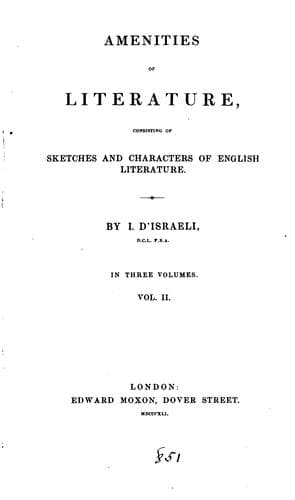
Amenities of Literature: Consisting of Sketches and Characters of English LiteratureDisraeli, Isaac
History
Amenities of Literature: Consisting of Sketches and Characters of English Literature
Disraeli, Isaac
Authors, English -- Biography; English literature -- History and criticism; Great Britain -- Intellectual life
The predilection for composing in the Roman language long continued
among the most illustrious writers both at home and abroad. A judicious
critic in the reign of James I., Edmund Bolton, in his "Nero Cæsar,"
recommends that the history of England should be composed in Latin by
the classical pen of the learned Sir Henry Saville, the editor of
"Chrysostom." It is indeed a curious circumstance that when an English
play was performed at the University of Cambridge before Queen
Elizabeth, the Vice-Chancellor was called on to remonstrate with the
ministers of Elizabeth against such a derogation of the learning and the
dignity of the University. This very Vice-Chancellor, who had to protest
against all English comedies, had, however, himself been the writer of
"Gammer Gurton's Needle," which was long considered to be the first
attempt at English comedy.[6] This conduct of the University offered no
encouragement to men of learning and genius to compose in their
vernacular idiom.
The genius of VERULAM, whose prescient views often anticipated the
institutions and the discoveries of succeeding times, appears never to
have contemplated the future miracles of his maternal tongue. Lord BACON
did not foresee that the English language would one day be capable of
embalming all that philosophy can discover or poetry can invent; that
his country, at length, would possess a national literature, and exult
in models of its own. So little did Lord Bacon esteem the language of
his country, that his favourite works are composed in Latin; and what he
had written in English he was anxious to have preserved, as he expresses
himself, in "that universal language which may last as long as books
last." It might have surprised Lord Bacon to have been told that the
learned in Europe would one day study English authors to learn to think
and write, and prefer his own "Essays," in their living pith, to the
colder transfusions of the Latin versions of his friends. The taste of
the philosophical Chancellor was probably inferior to his invention. Our
illustrious CAMDEN partook largely of this reigning fatuity when he
wrote the reign of Elizabeth--the history of his contemporaries, and the
"Britannia"--the history of our country, in the Latin language; as did
BUCHANAN that of Scotland, and DE THOU his great history, which includes
that of the Reformation in France. All these works, addressed to the
deepest sympathies of the people, were not imparted to them.
Public-domain text, read in full here on John Shaqi.
Reviews
Reviews
No reviews yet
Be the first to share your thoughts on this work.
Elsewhere in the archive
Join the Discussion
Join the discussion
Sign in to leave a comment or review.
Sign InorCreate an account