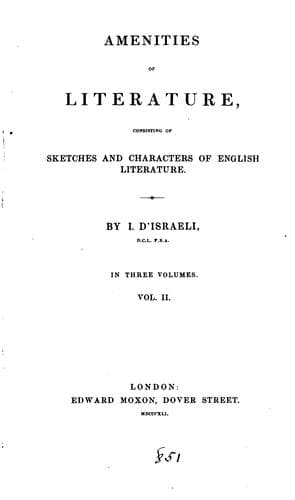
Amenities of Literature: Consisting of Sketches and Characters of English LiteratureDisraeli, Isaac
History
Amenities of Literature: Consisting of Sketches and Characters of English Literature
Disraeli, Isaac
Authors, English -- Biography; English literature -- History and criticism; Great Britain -- Intellectual life
that his only safety was to abstain from using the great instrument of
his art, which was now locked up in silence. He was left, as he
expresses himself, "without all help and without all hope, not only of
liberty, but also of life." He escaped by a strange incident. It would
seem that in an insurrection of the populace they set fire to the
prison, and in a burst of popular freedom, forgetful of their bigotry,
or from the spirit of vengeance on their hateful masters, they suffered
the heretics to creep out of their cells; an ebullition of public spirit
in "the worthy Romans," which the luckless English expounder of logic
and rhetoric might well account as "an enterprise never before
attempted." On Wilson's return to England be was solicited to revise his
admirable "Art of Rhetoric," but he strenuously refused to "meddle with
it, either hot or cold." Still smarting from the torture which his
innocent progeny had occasioned, he seems to have alleviated his
martyrdom with the quaint humour of a querulous prologue.
In these awful transitions from one state of society to another, even
the most sagacious are predisposed to discover what they secretly wish.
Erasmus foresaw that a great change was approaching; but although he has
delivered a prediction, it seems doubtful whether he had discerned the
object aright. "I see," he writes, "a certain golden age ready to arise,
which perhaps will not be my lot to partake of, yet I congratulate the
world, and the younger sort I congratulate, in whose minds, however,
Erasmus shall live and remain, by the remembrance of good offices he
hath done." These "good offices" were restricted to his ardent labours
in classical literature; but did Erasmus foresee in the change the
subversion of the papal system by which Luther had often terrified the
timid quietness of our gentle recluse, or the rise of the vernacular
literature which had yet no existence? Erasmus, indeed, was so little
sensible of this approaching change, that his amusing Colloquies, and
his Panegyric on Folly, whose satirical humour had been so happily
adapted to open the minds of men, he confined to the lettered circles;
as Sir Thomas More did his "Utopia," which, had it been intelligible to
the people, might have impressed them with some principles of political
government. The Sage of Rotterdam imagined that the great movement of
the age was to restore the classical pursuits of antiquity, and never
dreamed of that which, in opposition to the ancient, soon obtained the
distinction of "the New Learning," as it is expressed by Roger
Ascham--the knowledge which was adapted to the wants and condition of
the people. Erasmus would have been startled at the truth, that the
language of antiquity would even be neglected by the generality of
writers; that every European nation would have classics of their own;
and that the finest geniuses would make their appeals to the people in
the language of the people.
Public-domain text, read in full here on John Shaqi.
Reviews
Reviews
No reviews yet
Be the first to share your thoughts on this work.
Elsewhere in the archive
Join the Discussion
Join the discussion
Sign in to leave a comment or review.
Sign InorCreate an account