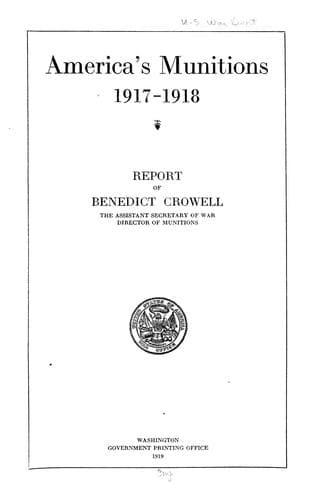
America's Munitions 1917-1918United States. War Department
History
America's Munitions 1917-1918
United States. War Department
United States. Army -- Supplies and stores; Weapons; World War, 1914-1918 -- United States -- Equipment and supplies
The submarine also had the effect of lessening the importations from
Chile of sodium nitrate, which prior to the war were depended upon
entirely in the production of nitric acid. It became necessary,
therefore, to develop other methods of production. After investigations
a plant for the fixation of nitrogen under what is known as a modified
Haber process was erected at Sheffield, Ala., while a plant for the
same purpose using the cyanamide process was erected at Muscle Shoals,
Ala.
Both of these were equipped for the oxidation of ammonia to nitric
acid, each using a different process. When the armistice was signed
these plants were just coming into production. The existence of these
two nitrate plants insures the independence of this country in its
supply of commercial nitrogen, either for peace or for war.
There were also in course of erection, though not in operation on
November 11, 1918, great plants for the extraction of nitrogen from
the air, at Toledo and Cincinnati, Ohio, but construction on these two
plants, each of which was to cost $25,000,000, was stopped when the
armistice was signed.
PROPELLANTS.
In army usage the term "propellant" includes both smokeless powder and
black powder.
At the outbreak of the European war, the producing capacity in this
country for smokeless powder was approximately 1,500,000 pounds a
month. By the time the United States got into the war this capacity had
been increased from 25 to 30 times, and under the explosives program
laid down by us it was indicated that even this capacity would have to
be greatly increased.
The increase in the production of smokeless powder was helped by the
construction of two of the largest smokeless-powder plants in the
world--one known as the Old Hickory Plant, located almost on the site
of Andrew Jackson's old home at Nashville, Tenn., and the other at
Nitro, near Charleston, W. Va.
The Old Hickory Plant was the larger and more complete of the two. It
is probably the biggest plant of its kind in the world and is entirely
self-contained; in other words, the plant actually takes the crude, raw
cotton and, producing both the acid and solvents used, puts it through
every process until the final product is attained.
Nine powder lines were planned for this enterprise, each with a
capacity of 100,000 pounds per day, although developments from the
early operations indicated that the ultimate production of the plant
would reach 1,000,000 pounds a day.
The estimated cost of this huge undertaking was in the neighborhood of
$90,000,000. Negotiations were begun in October of 1917 and led to a
contract with the du Pont Engineering Co., under which this concern was
to construct the plant and operate it for a six months' period after
its completion.
Public-domain text, read in full here on John Shaqi.
Reviews
Reviews
No reviews yet
Be the first to share your thoughts on this work.
Elsewhere in the archive
Join the Discussion
Join the discussion
Sign in to leave a comment or review.
Sign InorCreate an account