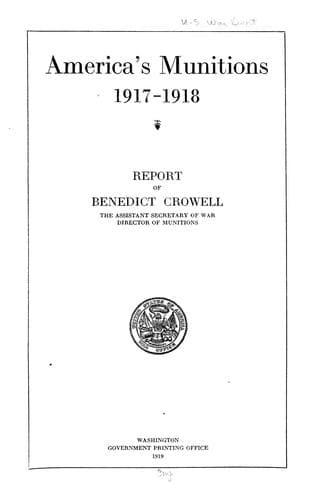
America's Munitions 1917-1918United States. War Department
History
America's Munitions 1917-1918
United States. War Department
United States. Army -- Supplies and stores; Weapons; World War, 1914-1918 -- United States -- Equipment and supplies
Starting with the artillery, there was first in order of size the baby
two-man cannon of 37 millimeters (about an inch and a half) in the
diameter of its bore--a European development new to our experience, so
light that it could be handled by foot troops in the field, used for
annihilating the enemy's machine-gun emplacements.
Then the mobile field guns--the famous 75's, the equivalent in size of
our former 3-inch gun, the 155-millimeter howitzer, the French 155
millimeter G. P. F. (Grand Puissance Filloux) gun of glorious record in
the war, and its American prototypes, the 4.7-inch, 5-inch, and 6-inch
guns--all of these employed to shell crossroads and harass the enemy's
middle area.
Beyond these were the 8-inch and 9.2-inch howitzers and the terrific
240-millimeter howitzer, for throwing great weights of destruction high
in air to descend with a plunge upon the enemy's strongest defenses.
Then there were the 8-inch, 10-inch, 12-inch, and 14-inch guns on
railway mounts, for pounding the depots and dumps in the enemy's back
areas. These weapons were so tremendous in weight when mounted as to
require from 16 to 24 axles on the car to distribute the load and the
recoil of firing within the limits of the strength of standard heavy
railway track.
All of these guns had to be produced in great numbers, if the future
requirements of the American forces were to be met, produced by the
thousands in the cases of the smaller ones and by the hundreds and
scores in the cases of the larger.
These weapons would be ineffective without adequate supplies of
ammunition. In the case of the mobile held guns this meant a
requirement of millions of shell or shrapnel for the incessant
bombardments and the concentrated barrages which characterized the
great war. The entire weight of projectiles fired in such an historic
engagement as Gettysburg would supply the artillery only for a few
minutes in such intensive bombardments as sowed the soil of Flanders
with steel.
The artillery demanded an immense amount of heavy equipment--limbers,
caissons, auto ammunition trucks, and tractors to drag the heavy and
middle-heavy artillery. Some of them were fitted with self-propelled
caterpillar mounts which could climb a 40° grade or make as high as 12
miles an hour on level ground. These, the adaptations to warfare of
peaceful farm and construction machine traction, for the first time
rendered the greater guns exceedingly mobile, enabling them to go into
action instantly upon arrival and to depart to safety just as soon as
their mission was accomplished.
Public-domain text, read in full here on John Shaqi.
Reviews
Reviews
No reviews yet
Be the first to share your thoughts on this work.
Join the Discussion
Join the discussion
Sign in to leave a comment or review.
Sign InorCreate an account