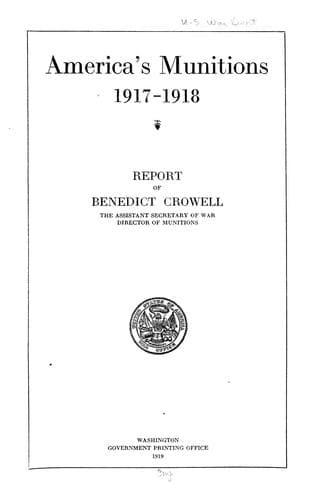
America's Munitions 1917-1918United States. War Department
History
America's Munitions 1917-1918
United States. War Department
United States. Army -- Supplies and stores; Weapons; World War, 1914-1918 -- United States -- Equipment and supplies
Our earliest thought was that we would need some 7,000,000 of these
grenades and orders for that quantity of bodies were placed in January
and March, 1918, with the Single Service Package Corporation. Then it
became necessary to discover factories which could produce the metal
caps. The orders for these were first placed with the Acme Die Castings
Co. and the National Lead Casting Co. for 3,375,000 castings from each
concern. But these companies failed to make satisfactory deliveries,
and in May, 1918, a contract for 5,000,000 caps was let to the Doehler
Die Castings Co. which reached quantity production in August. After
that the Single Service Package Corporation, the chief contractor,
forged ahead in its work and on November 11 was producing the bodies
for offensive grenades at the rate of 55,000 to 60,000 daily. By
December 6, 1918, the Government had accepted 6,179,321 completed
bodies. The signing of the armistice brought to an end a project to
build 17,599,000 additional grenades of this type.
The production of gas grenades offered some peculiar difficulties.
We set out at first to produce 3,684,530 of them. By January, 1918,
the engineers of the Ordnance Department had completed the plans and
specifications for the American gas grenade, and on February 12, an
order for 1,000,000 of them was placed with the Maxim Silencer Co., of
Hartford, Conn.
The gas grenades were to be delivered at the filling plants complete
except for the detonator thimbles, which seal both gas and phosphorus
grenades and act as sockets for the firing mechanism. It was seen
that the construction of these thimbles might be a choke point in the
construction of grenades of both types, and orders were early placed
for them--1,500,000 to be delivered by the Maxim Silencer Co. and an
equal quantity by the Bassic Co., of Bridgeport, Conn. On December 6,
1918, these concerns had produced 1,982,731 detonator thimbles.
The body of the gas grenade is built of two sheet-metal cups welded
together to be gas-tight. Since, when we started out on this
production, we did not know what kind of gas would be used or at what
pressure it would be held within the grenade, we set the specifications
to make grenade bodies to hold an air pressure of 200 pounds. The
welding of the cups frequently failed to hold such pressure, so that
the rejections of gas-grenade bodies under this test ran as high as
50 per cent. But in June, 1918, the gas for the grenades had been
developed, and we were thereupon able to reduce the pressure of the
standard test to 50 pounds. Under such a test the bodies readily passed
inspection.
In September, 1918, we let additional contracts for gas
grenades--500,000 to the Evinrude Motor Co., of Milwaukee; 500,000 to
the John W. Brown Manufacturing Co., of Columbus, Ohio; and 400,000 to
the Zenite Metal Co., of Indianapolis.
On November 11 gas grenade bodies were being produced at the rate of
22,000 per day, and the total production up to December 6 was 936,394.
Public-domain text, read in full here on John Shaqi.
Reviews
Reviews
No reviews yet
Be the first to share your thoughts on this work.
Elsewhere in the archive
Join the Discussion
Join the discussion
Sign in to leave a comment or review.
Sign InorCreate an account