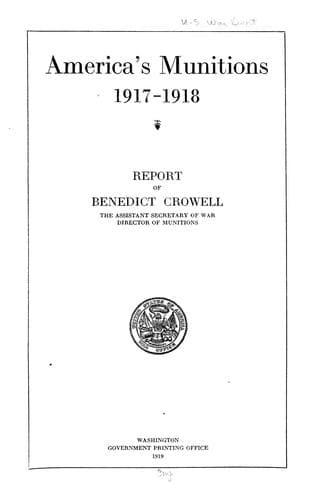
America's Munitions 1917-1918United States. War Department
History
America's Munitions 1917-1918
United States. War Department
United States. Army -- Supplies and stores; Weapons; World War, 1914-1918 -- United States -- Equipment and supplies
The phosphorus grenade was similar to the gas grenade in construction.
The plans and specifications for this weapon were ready in January,
1918. In February the following contracts were let: Metropolitan
Engineering Co., Brooklyn, N. Y., 750,000; Evinrude Motor Co.,
Milwaukee, 750,000; Zenite Metal Co., Indianapolis, 500,000. On
December 6, 1918, these concerns had delivered a total of 521,948
phosphorus grenade bodies.
The difficulties which had been experienced in the production of gas
grenades were repeated in this project. The Evinrude Co. was especially
quick in getting over the obstacles to quantity production. The
Metropolitan Engineering Co. was already engaged with large orders for
adapters and boosters in the heavy-gun ammunition manufacture for the
Ordnance Department and found that the order for phosphorus grenades
conflicted to a considerable extent with its previous war work. The
matter was thrashed out in the Ordnance Department, which gave the
priority in this plant to the adapters and boosters, with the result
that this firm was able to make only a small contribution to the total
production of phosphorus grenade bodies.
The development of thermit grenades was still in the experimental
stage when the armistice was signed. There was no actual production
in this country of grenades of this character. In October, however,
the development of the grenade in design had reached a stage where we
felt justified in letting a contract for 655,450 die-casting parts to
the Doehler Die Castings Co., at its Toledo plant, and for an equal
number of bodies with firing-mechanism assemblies to the Stewart-Warner
Speedometer Corporation at Chicago.
The incendiary grenade not only did not get out of the development
stage, but even a perfected model was regarded as of doubtful value by
the officers of the American Expeditionary Forces. Nevertheless, the
Chemical Warfare Service was of the opinion that such a grenade should
be worked out, and an order for 81,000 had been given to the Celluloid
Co., of Newark, N. J. Experimental work was progressing satisfactorily
when the armistice was signed.
When the war ended, we were adapting to American manufacture a
combination hand and rifle phosphorus grenade, borrowed from the
English. The body of this grenade was built of terneplate and it had a
removable stem, so that it could be thrown by hand or fired from the
end of a service rifle. The American Can Co. built 1,000 of these to
try out the design and strengthen the weak features.
Public-domain text, read in full here on John Shaqi.
Reviews
Reviews
No reviews yet
Be the first to share your thoughts on this work.
Elsewhere in the archive
Join the Discussion
Join the discussion
Sign in to leave a comment or review.
Sign InorCreate an account