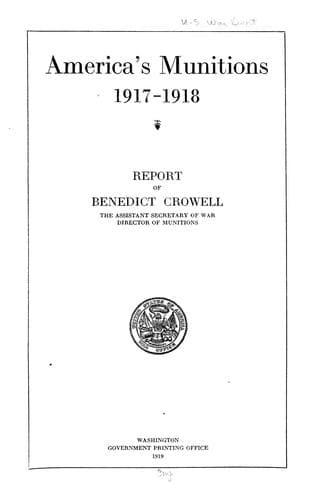
America's Munitions 1917-1918United States. War Department
History
America's Munitions 1917-1918
United States. War Department
United States. Army -- Supplies and stores; Weapons; World War, 1914-1918 -- United States -- Equipment and supplies
It was obvious that the manufacture of this and of other larger mortars
would fall into three phases. The forging of barrels, breechblocks,
and breech slides was a separate type of work, and we allotted the
contracts for this work to the Standard Forging Co., of Indiana Harbor,
Ind. The machining of these parts to the fine dimensions required by
the design was an entirely separate phase of manufacturing, and we
placed this work with the American Laundry Machine Co., of Cincinnati.
Still a third class of work was that of assembling the completed
mortars, and this contract went to the David Lupton Sons Co., of
Philadelphia, who also engaged to manufacture the metal and timber
bases and firing mechanisms. These big mortars had to have mobile
mountings, and the contract for the mortar carts we placed with the
International Harvester Co., of Chicago. These contracts were signed in
December, 1917.
The Lupton plant had difficulty in securing the heavy machinery
it needed for this and for other mortar contracts, its machinery
being held up by the freight congestion. Early in 1918 the American
Expeditionary Forces advised us to redesign the 240-millimeter mortar
to give it a stronger barrel. Consequently all work was stopped until
this could be done. The first mortars of the new design to be tested
were still unsatisfactory with respect to the strength of the barrels;
and as a consequence the Standard Forging Co. urged that nickel steel
be substituted for basic open-hearth steel as the material for the
barrels. This change proved to be justified.
There was also trouble at the shops of the American Laundry Machine
Co., its equipment not having the precision to do machining of the
type required in these weapons. Accordingly a new machining contract
was made with the Symington-Anderson Co., of Rochester, N. Y., which
concern was eventually able to reach a production of 20 machined
barrels per week.
In all we produced 24 of the 240-millimeter mortars in this country.
Certain of the parts were manufactured up to the total requirements
of the contracts, but others were not built in such numbers. The
International Harvester Co. built all 999 carts ordered.
The production of shell for these big mortars was another difficult
undertaking. After consultation with manufacturers we designed shell of
two different types. One of these was a shell of pressed plates welded
together longitudinally; and a contract for the production of 283,096
of these was placed with the Metropolitan Engineering Co. The other
form was that of two steel hemispheres welded together. The Michigan
Stamping Co., of Detroit, undertook to build 50,000 of these.
Public-domain text, read in full here on John Shaqi.
Reviews
Reviews
No reviews yet
Be the first to share your thoughts on this work.
Elsewhere in the archive
Join the Discussion
Join the discussion
Sign in to leave a comment or review.
Sign InorCreate an account