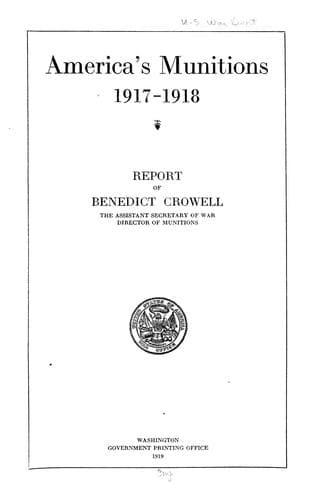
America's Munitions 1917-1918United States. War Department
History
America's Munitions 1917-1918
United States. War Department
United States. Army -- Supplies and stores; Weapons; World War, 1914-1918 -- United States -- Equipment and supplies
With a view, therefore, first to expedite and facilitate the
equipment of the American armies in France, and, second, to
secure the maximum ultimate development of the ammunition
supply with the minimum strain upon available tonnage, the
representatives of Great Britain and France propose that
the American field, medium, and heavy artillery be supplied
during 1918, and as long after as may be found convenient,
from British and French gun factories; and they ask: (A) That
the American efforts shall be immediately directed to the
production of propellants and high explosives on the largest
possible scale; and (B) Great Britain also asks that the
6-inch, 8-inch, and 9.2-inch shell plants already created for
the British service in the United States shall be maintained in
the highest activity, and that large additional plants for the
manufacture of these shells shall at once be laid down.
In this way alone can the tonnage difficulty be minimised and
potential artillery development, both in guns and shells, of
the combined French, British, and American armies be maintained
in 1918 and still more in 1919.
This agreement had a profound effect upon American production of
munitions. Most important of all, it gave us time; time to build
manufacturing capacity on a grand scale without the hampering necessity
for immediate production; time to secure the best in design; time to
attain quality in the enormous output to come later as opposed to early
quantity of indifferent class.
In the late autumn of 1917, shortly after Russia collapsed and
withdrew from the war, it became evident that Germany would seize the
opportunity to move her troops from the eastern front and concentrate
her entire army against the French and British in 1918.
This intelligence at once resulted in fresh emphasis upon the man-power
phase of American cooperation. As early as December, 1917, the War
Department was anticipating the extraordinary need for men in the
coming spring by considering plans for the transport of troops up to
the supposed limit of the capacity of all available American ships,
with what additional tonnage Great Britain and the other Allies could
spare us. It is of record that the actual dispatch of troops to France
far outstripped these early estimates.
Public-domain text, read in full here on John Shaqi.
Reviews
Reviews
No reviews yet
Be the first to share your thoughts on this work.
Join the Discussion
Join the discussion
Sign in to leave a comment or review.
Sign InorCreate an account