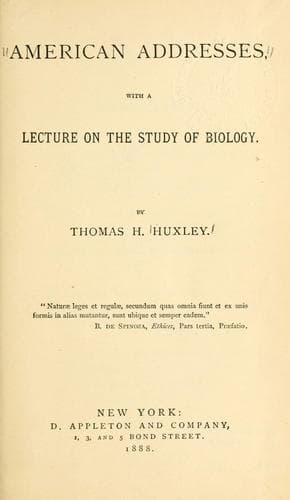
American Addresses, with a Lecture on the Study of BiologyHuxley, Thomas Henry
Science
American Addresses, with a Lecture on the Study of Biology
Huxley, Thomas Henry
Biology -- Study and teaching; Evolution; Johns Hopkins University
E-text prepared by Clare Boothby, Jeremy Weatherford, and the Project
Gutenberg Online Distributed Proofreading Team (https://www.pgdp.net)
Note: Project Gutenberg also has an HTML version of this
file which includes the original illustrations.
See 16136-h.htm or 16136-h.zip:
(https://www.gutenberg.org/dirs/1/6/1/3/16136/16136-h/16136-h.htm)
or
(https://www.gutenberg.org/dirs/1/6/1/3/16136/16136-h.zip)
AMERICAN ADDRESSES, WITH A LECTURE ON THE STUDY OF BIOLOGY
by
THOMAS H. HUXLEY.
London: MacMillan and Co.
London: R. Clay, Sons, and Taylor, Printers, Bread Street Hill,
Queen Victoria Street.
1877
"Naturæ leges et regulæ, secundum quas omnia fiunt et ex unis
formis in alias mutantur, sunt ubique et semper eadem."
B. DE SPINOZA, _Ethices_, Pars tertia, Præfatio.
CONTENTS.
I. THREE LECTURES ON EVOLUTION (New York, September 18, 20, 22, 1876).
LECTURE I. THE THREE HYPOTHESES RESPECTING THE HISTORY OF NATURE
LECTURE II. THE HYPOTHESIS OF EVOLUTION. THE NEUTRAL AND THE
FAVOURABLE EVIDENCE
LECTURE III. THE DEMONSTRATIVE EVIDENCE OF EVOLUTION
II. AN ADDRESS ON THE OCCASION OF THE OPENING OF THE JOHNS HOPKINS
UNIVERSITY (Baltimore, September 12, 1876)
III. A LECTURE ON THE STUDY OF BIOLOGY, IN CONNECTION WITH THE LOAN
COLLECTION OF SCIENTIFIC APPARATUS (South Kensington Museum,
December 16, 1876)
NEW YORK.
LECTURES ON EVOLUTION.
LECTURE I.
THE THREE HYPOTHESES RESPECTING THE HISTORY OF NATURE.
We live in and form part of a system of things of immense diversity and
perplexity, which we call Nature; and it is a matter of the deepest
interest to all of us that we should form just conceptions of the
constitution of that system and of its past history. With relation to
this universe, man is, in extent, little more than a mathematical point;
in duration but a fleeting shadow; he is a mere reed shaken in the winds
of force. But, as Pascal long ago remarked, although a mere reed, he is
a thinking reed; and in virtue of that wonderful capacity of thought, he
has the power of framing for himself a symbolic conception of the
universe, which, although doubtless highly imperfect and inadequate as a
picture of the great whole, is yet sufficient to serve him as a chart
for the guidance of his practical affairs. It has taken long ages of
toilsome and often fruitless labour to enable man to look steadily at
the shifting scenes of the phantasmagoria of Nature, to notice what is
fixed among her fluctuations, and what is regular among her apparent
irregularities; and it is only comparatively lately, within the last few
centuries, that the conception of a universal order and of a definite
course of things, which we term the course of Nature, has emerged.
Public-domain text, read in full here on John Shaqi.
Reviews
Reviews
No reviews yet
Be the first to share your thoughts on this work.
Join the Discussion
Join the discussion
Sign in to leave a comment or review.
Sign InorCreate an account