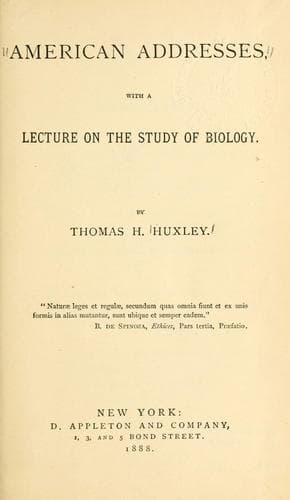
American Addresses, with a Lecture on the Study of Biology — John Shaqi
American Addresses, with a Lecture on the Study of BiologyHuxley, Thomas Henry
Science
American Addresses, with a Lecture on the Study of Biology
Huxley, Thomas Henry
Biology -- Study and teaching; Evolution; Johns Hopkins University
But there is still stronger evidence of the long duration of certain
types. I have already stated that, as we work our way through the great
series of the Tertiary formations, we find many species of animals
identical with those which live at the present day, diminishing in
numbers, it is true, but still existing, in a certain proportion, in the
oldest of the Tertiary rocks. Furthermore, when we examine the rocks of
the Cretaceous epoch, we find the remains of some animals which the
closest scrutiny cannot show to be, in any important respect, different
from those which live at the present time. That is the case with one of
the cretaceous lamp-shells (_Terebratula_), which has continued to exist
unchanged, or with insignificant variations, down to the present day.
Such is the case with the _Globigerinæ_, the skeletons of which,
aggregated together, form a large proportion of our English chalk. Those
_Globigerinæ_ can be traced down to the _Globigerinæ_ which live at the
surface of the present great oceans, and the remains of which, falling
to the bottom of the sea, give rise to a chalky mud. Hence it must be
admitted that certain existing species of animals show no distinct sign
of modification, or transformation, in the course of a lapse of time as
great as that which carries us back to the Cretaceous period; and which,
whatever its absolute measure, is certainly vastly greater than thirty
thousand years.
There are groups of species so closely allied together that it needs the
eye of a naturalist to distinguish them one from another. If we
disregard the small differences which separate these forms and consider
all the species of such groups as modifications of one type, we shall
find that, even among the higher animals, some types have had a
marvellous duration. In the chalk, for example, there is found a fish
belonging to the highest and the most differentiated group of osseous
fishes, which goes by the name of _Beryx_. The remains of that fish are
among the most beautiful and well preserved of the fossils found in our
English chalk. It can be studied anatomically, so far as the hard parts
are concerned, almost as well as if it were a recent fish. But the genus
_Beryx_ is represented, at the present day, by very closely allied
species which are living in the Pacific and Atlantic Oceans. We may go
still farther back. I have already referred to the fact that the
Carboniferous formations, in Europe and in America, contain the remains
of scorpions in an admirable state of preservation, and that those
scorpions are hardly distinguishable from such as now live. I do not
mean to say that they are not different, but close scrutiny is needed in
order to distinguish them from modern scorpions.
Public-domain text, read in full here on John Shaqi.
Reviews
Reviews
No reviews yet
Be the first to share your thoughts on this work.
Join the Discussion
Join the discussion
Sign in to leave a comment or review.
Sign InorCreate an account