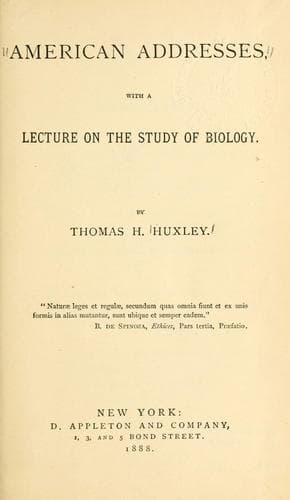
American Addresses, with a Lecture on the Study of BiologyHuxley, Thomas Henry
Science
American Addresses, with a Lecture on the Study of Biology
Huxley, Thomas Henry
Biology -- Study and teaching; Evolution; Johns Hopkins University
constantly washed down by rain and rivers and deposited in the sea; and
that thus, in a longer or shorter time, the inequalities of the earth's
surface must be levelled, and its high lands brought down to the ocean.
But, taking into account the internal forces of the earth, which,
upheaving the sea-bottom give rise to new land, he thought that these
operations of degradation and elevation might compensate each other; and
that thus, for any assignable time, the general features of our planet
might remain what they are. And inasmuch as, under these circumstances,
there need be no limit to the propagation of animals and plants, it is
clear that the consistent working-out of the uniformitarian idea might
lead to the conception of the eternity of the world. Not that I mean to
say that either Hutton or Lyell held this conception--assuredly not;
they would have been the first to repudiate it. Nevertheless, the
logical development of their arguments tends directly towards this
hypothesis.
The second hypothesis supposes that the present order of things, at some
no very remote time, had a sudden origin, and that the world, such as it
now is, had chaos for its phenomenal antecedent. That is the doctrine
which you will find stated most fully and clearly in the immortal poem
of John Milton--the English _Divina Commedia--Paradise Lost_. I believe
it is largely to the influence of that remarkable work, combined with
the daily teachings to which we have all listened in our childhood, that
this hypothesis owes its general wide diffusion as one of the current
beliefs of English-speaking people. If you turn to the seventh book of
_Paradise Lost_, you will find there stated the hypothesis to which I
refer, which is briefly this: That this visible universe of ours came
into existence at no great distance of time from the present; and that
the parts of which it is composed made their appearance, in a certain
definite order, in the space of six natural days, in such a manner that,
on the first of these days, light appeared; that, on the second, the
firmament, or sky, separated the waters above, from the waters beneath
the firmament; that, on the third day, the waters drew away from the dry
land, and upon it a varied vegetable life, similar to that which now
exists, made its appearance; that the fourth day was signalised by the
apparition of the sun, the stars, the moon, and the planets; that, on
the fifth day, aquatic animals originated within the waters; that, on
the sixth day, the earth gave rise to our four-footed terrestrial
creatures, and to all varieties of terrestrial animals except birds,
which had appeared on the preceding day; and, finally, that man appeared
upon the earth, and the emergence of the universe from chaos was
finished. Milton tells us, without the least ambiguity, what a spectator
of these marvellous occurrences would have witnessed. I doubt not that
his poem is familiar to all of you, but I should like to recall one
Public-domain text, read in full here on John Shaqi.
Reviews
Reviews
No reviews yet
Be the first to share your thoughts on this work.
Join the Discussion
Join the discussion
Sign in to leave a comment or review.
Sign InorCreate an account