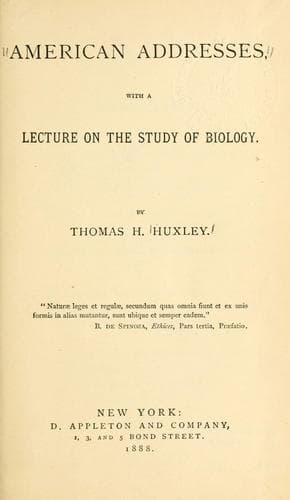
American Addresses, with a Lecture on the Study of BiologyHuxley, Thomas Henry
Science
American Addresses, with a Lecture on the Study of Biology
Huxley, Thomas Henry
Biology -- Study and teaching; Evolution; Johns Hopkins University
What is the object of medical education? It is to enable the
practitioner, on the one hand, to prevent disease by his knowledge of
hygiene; on the other hand, to divine its nature, and to alleviate or
cure it, by his knowledge of pathology, therapeutics, and practical
medicine. That is his business in life, and if he has not a thorough and
practical knowledge of the conditions of health, of the causes which
tend to the establishment of disease, of the meaning of symptoms, and of
the uses of medicines and operative appliances, he is incompetent, even
if he were the best anatomist, or physiologist, or chemist, that ever
took a gold medal or won a prize certificate. This is one great truth
respecting medical education. Another is, that all practice in medicine
is based upon theory of some sort or other; and therefore, that it is
desirable to have such theory in the closest possible accordance with
fact. The veriest empiric who gives a drug in one case because he has
seen it do good in another of apparently the same sort, acts upon the
theory that similarity of superficial symptoms means similarity of
lesions; which, by the way, is perhaps as wild an hypothesis as could be
invented. To understand the nature of disease we must understand health,
and the understanding of the healthy body means the having a knowledge
of its structure and of the way in which its manifold actions are
performed, which is what is technically termed human anatomy and human
physiology. The physiologist again must needs possess an acquaintance
with physics and chemistry, inasmuch as physiology is, to a great
extent, applied physics and chemistry. For ordinary purposes a limited
amount of such knowledge is all that is needful; but for the pursuit of
the higher branches of physiology no knowledge of these branches of
science can be too extensive, or too profound. Again, what we call
therapeutics, which has to do with the action of drugs and medicines on
the living organism, is, strictly speaking, a branch of experimental
physiology, and is daily receiving a greater and greater experimental
development.
Public-domain text, read in full here on John Shaqi.
Reviews
Reviews
No reviews yet
Be the first to share your thoughts on this work.
Elsewhere in the archive
Join the Discussion
Join the discussion
Sign in to leave a comment or review.
Sign InorCreate an account