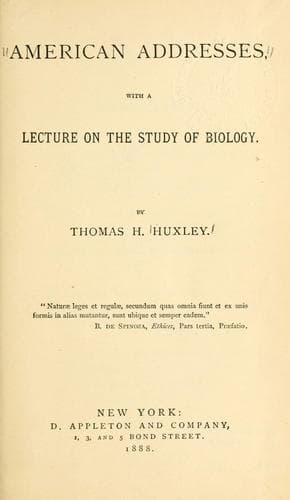
American Addresses, with a Lecture on the Study of BiologyHuxley, Thomas Henry
Science
American Addresses, with a Lecture on the Study of Biology
Huxley, Thomas Henry
Biology -- Study and teaching; Evolution; Johns Hopkins University
The third great fact which is to be taken into consideration in dealing
with medical education, is that the practical necessities of life do
not, as a rule, allow aspirants to medical practice to give more than
three, or it may be four years to their studies. Let us put it at four
years, and then reflect that, in the course of this time, a young man
fresh from school has to acquaint himself with medicine, surgery,
obstetrics, therapeutics, pathology, hygiene, as well as with the
anatomy and the physiology of the human body; and that his knowledge
should be of such a character that it can be relied upon in any
emergency, and always ready for practical application. Consider, in
addition, that the medical practitioner may be called upon, at any
moment, to give evidence in a court of justice in a criminal case; and
that it is therefore well that he should know something of the laws of
evidence, and of what we call medical jurisprudence. On a medical
certificate, a man may be taken from his home and from his business and
confined in a lunatic asylum; surely, therefore, it is desirable that
the medical practitioner should have some rational and clear conceptions
as to the nature and symptoms of mental disease. Bearing in mind all
these requirements of medical education, you will admit that the burden
on the young aspirant for the medical profession is somewhat of the
heaviest, and that it needs some care to prevent his intellectual back
from being broken.
Those who are acquainted with the existing systems of medical education
will observe that, long as is the catalogue of studies which I have
enumerated, I have omitted to mention several that enter into the usual
medical curriculum of the present day. I have said not a word about
zoology, comparative anatomy, botany, or materia medica. Assuredly this
is from no light estimate of the value or importance of such studies in
themselves. It may be taken for granted that I should be the last person
in the world to object to the teaching of zoology, or comparative
anatomy, in themselves; but I have the strongest feeling that,
considering the number and the gravity of those studies through which a
medical man must pass, if he is to be competent to discharge the serious
duties which devolve upon him, subjects which lie so remote as these do
from his practical pursuits should be rigorously excluded. The young
man, who has enough to do in order to acquire such familiarity with the
structure of the human body as will enable him to perform the operations
of surgery, ought not, in my judgment, to be occupied with
investigations into the anatomy of crabs and starfishes. Undoubtedly the
doctor should know the common poisonous plants of his own country when
he sees them; but that knowledge may be obtained by a few hours devoted
to the examination of specimens of such plants, and the desirableness of
such knowledge is no justification, to my mind, for spending three
months over the study of systematic botany.
Public-domain text, read in full here on John Shaqi.
Reviews
Reviews
No reviews yet
Be the first to share your thoughts on this work.
Elsewhere in the archive
Join the Discussion
Join the discussion
Sign in to leave a comment or review.
Sign InorCreate an account