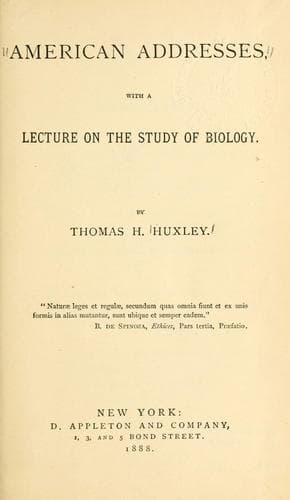
American Addresses, with a Lecture on the Study of BiologyHuxley, Thomas Henry
Science
American Addresses, with a Lecture on the Study of Biology
Huxley, Thomas Henry
Biology -- Study and teaching; Evolution; Johns Hopkins University
But as science made the marvellous progress which it did make at the
latter end of the last and the beginning of the present century,
thinking men began to discern that under this title of "Natural History"
there were included very heterogeneous constituents--that, for example,
geology and mineralogy were, in many respects, widely different from
botany and zoology; that a man might obtain an extensive knowledge of
the structure and functions of plants and animals, without having need
to enter upon the study of geology or mineralogy, and _vice versâ_; and,
further as knowledge advanced, it became clear that there was a great
analogy, a very close alliance, between those two sciences of botany and
zoology which deal with living beings, while they are much more widely
separated from all other studies. It is due to Buffon to remark that he
clearly recognised this great fact. He says: "Ces deux genres d'êtres
organisés [les animaux et les végétaux] ont beaucoup plus de propriétés
communes que de différences réelles." Therefore, it is not wonderful
that, at the beginning of the present century, in two different
countries, and so far as I know, without any intercommunication, two
famous men clearly conceived the notion of uniting the sciences which
deal with living matter into one whole, and of dealing with them as one
discipline. In fact, I may say there were three men to whom this idea
occurred contemporaneously, although there were but two who carried it
into effect, and only one who worked it out completely. The persons to
whom I refer were the eminent physiologist Bichat, and the great
naturalist Lamarck, in France; and a distinguished German, Treviranus.
Bichat[1] assumed the existence of a special group of "physiological"
sciences. Lamarck, in a work published in 1801,[2] for the first time
made use of the name "Biologie" from the two Greek words which signify a
discourse upon life and living things. About the same time it occurred
to Treviranus, that all those sciences which deal with living matter are
essentially and fundamentally one, and ought to be treated as a whole;
and, in the year 1802, he published the first volume of what he also
called "Biologie." Treviranus's great merit lies in this, that he worked
out his idea, and wrote the very remarkable book to which I refer. It
consists of six volumes, and occupied its author for twenty years--from
1802 to 1822.
Public-domain text, read in full here on John Shaqi.
Reviews
Reviews
No reviews yet
Be the first to share your thoughts on this work.
Elsewhere in the archive
Join the Discussion
Join the discussion
Sign in to leave a comment or review.
Sign InorCreate an account