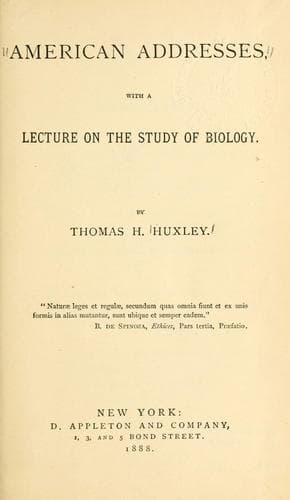
American Addresses, with a Lecture on the Study of BiologyHuxley, Thomas Henry
Science
American Addresses, with a Lecture on the Study of Biology
Huxley, Thomas Henry
Biology -- Study and teaching; Evolution; Johns Hopkins University
That is the origin of the term "Biology;" and that is how it has come
about that all clear thinkers and lovers of consistent nomenclature have
substituted for the old confusing name of "Natural History," which has
conveyed so many meanings, the term "Biology" which denotes the whole of
the sciences which deal with living things, whether they be animals or
whether they be plants. Some little time ago--in the course of this
year, I think--I was favoured by a learned classic, Dr. Field of
Norwich, with a disquisition, in which he endeavoured to prove that,
from a philological point of view, neither Treviranus nor Lamarck had
any right to coin this new word "Biology" for their purpose; that, in
fact, the Greek word "Bios" had relation only to human life and human
affairs, and that a different word was employed by the Greeks when they
wished to speak of the life of animals and plants. So Dr. Field tells us
we are all wrong in using the term biology, and that we ought to employ
another; only he is not quite sure about the propriety of that which he
proposes as a substitute. It is a somewhat hard one--"zootocology." I am
sorry we are wrong, because we are likely to continue so. In these
matters we must have some sort of "Statute of Limitations." When a name
has been employed for half-a-century, persons of authority[3] have been
using it, and its sense has become well understood, I am afraid that
people will go on using it, whatever the weight of philological
objection.
Now that we have arrived at the origin of this word "Biology," the next
point to consider is: What ground does it cover? I have said that, in
its strict technical sense, it denotes all the phenomena which are
exhibited by living things, as distinguished from those which are not
living; but while that is all very well, so long as we confine ourselves
to the lower animals and to plants, it lands us in considerable
difficulties when we reach the higher forms of living things. For
whatever view we may entertain about the nature of man, one thing is
perfectly certain, that he is a living creature. Hence, if our
definition is to be interpreted strictly, we must include man and all
his ways and works under the head of Biology; in which case, we should
find that psychology, politics, and political economy would be absorbed
into the province of Biology. In fact, civil history would be merged in
natural history. In strict logic it may be hard to object to this
course, because no one can doubt that the rudiments and outlines of our
own mental phenomena are traceable among the lower animals. They have
their economy and their polity, and if, as is always admitted, the
polity of bees and the commonwealth of wolves fall within the purview of
the biologist proper, it becomes hard to say why we should not include
therein human affairs, which in so many cases resemble those of the bees
in zealous getting, and are not without a certain parity in the
proceedings of the wolves.
Public-domain text, read in full here on John Shaqi.
Reviews
Reviews
No reviews yet
Be the first to share your thoughts on this work.
Elsewhere in the archive
Join the Discussion
Join the discussion
Sign in to leave a comment or review.
Sign InorCreate an account