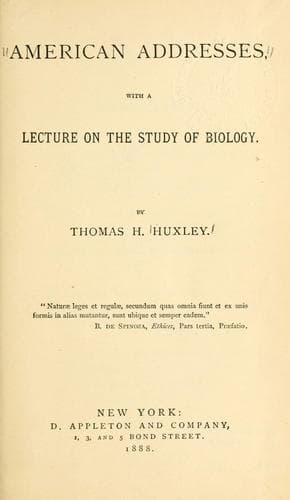
American Addresses, with a Lecture on the Study of BiologyHuxley, Thomas Henry
Science
American Addresses, with a Lecture on the Study of Biology
Huxley, Thomas Henry
Biology -- Study and teaching; Evolution; Johns Hopkins University
At the present moment you will be kind enough to separate me from them,
because it is in no way essential to my present argument that I should
advocate their views. Don't suppose that I am saying this for the
purpose of escaping the responsibility of their beliefs; indeed, at
other times and in other places, I do not think that point has been left
doubtful; but I want clearly to point out to you that for my present
argument they may all be wrong; and, nevertheless, my argument will hold
good. The biologists tell us that all this is an entire mistake. They
turn to the physical organisation of man. They examine his whole
structure, his bony frame and all that clothes it. They resolve him into
the finest particles into which the microscope will enable them to break
him up. They consider the performance of his various functions and
activities, and they look at the manner in which he occurs on the
surface of the world. Then they turn to other animals, and taking the
first handy domestic animal--say a dog--they profess to be able to
demonstrate that the analysis of the dog leads them, in gross, to
precisely the same results as the analysis of the man; that they find
almost identically the same bones, having the same relations; that they
can name the muscles of the dog by the names of the muscles of the man,
and the nerves of the dog by those of the nerves of the man, and that,
such structures and organs of sense as we find in the man such also we
find in the dog; they analyse the brain and spinal cord, and they find
that the nomenclature which fits the one answers for the other. They
carry their microscopic inquiries in the case of the dog as far as they
can, and they find that his body is resolvable into the same elements as
those of the man. Moreover, they trace back the dog's and the man's
development, and they find that, at a certain stage of their existence,
the two creatures are not distinguishable the one from the other; they
find that the dog and his kind have a certain distribution over the
surface of the world, comparable in its way to the distribution of the
human species. What is true of the dog they tell us is true of all the
higher animals; and they assert that they can lay down a common plan for
the whole of these creatures, and regard the man and the dog, the horse
and the ox as minor modifications of one great fundamental unity.
Moreover, the investigations of the last three-quarters of a century
have proved, they tell us, that similar inquiries, carried out through
all the different kinds of animals which are met with in nature, will
lead us, not in one straight series, but by many roads, step by step,
gradation by gradation, from man, at the summit, to specks of animated
jelly at the bottom of the series. So that the idea of Leibnitz, and of
Bonnet, that animals form a great scale of being, in which there are a
series of gradations from the most complicated form to the lowest and
Public-domain text, read in full here on John Shaqi.
Reviews
Reviews
No reviews yet
Be the first to share your thoughts on this work.
Elsewhere in the archive
Join the Discussion
Join the discussion
Sign in to leave a comment or review.
Sign InorCreate an account