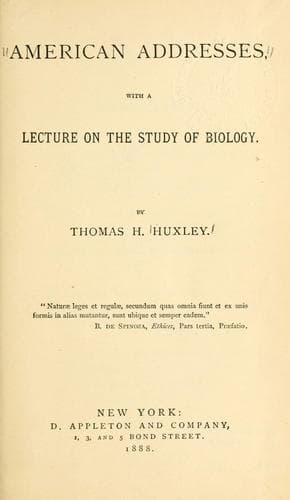
American Addresses, with a Lecture on the Study of BiologyHuxley, Thomas Henry
Science
American Addresses, with a Lecture on the Study of Biology
Huxley, Thomas Henry
Biology -- Study and teaching; Evolution; Johns Hopkins University
simplest; that idea, though not exactly in the form in which it was
propounded by those philosophers, turns out to be substantially correct.
More than this, when biologists pursue their investigations into the
vegetable world, they find that they can, in the same way, follow out
the structure of the plant, from the most gigantic and complicated trees
down through a similar series of gradations, until they arrive at specks
of animated jelly, which they are puzzled to distinguish from those
specks which they reached by the animal road.
Thus, biologists have arrived at the conclusion that a fundamental
uniformity of structure pervades the animal and vegetable worlds, and
that plants and animals differ from one another simply as diverse
modifications of the same great general plan.
Again, they tell us the same story in regard to the study of function.
They admit the large and important interval which, at the present time,
separates the manifestations of the mental faculties observable in the
higher forms of mankind, and even in the lower forms, such as we know
them, from those exhibited by other animals; but, at the same time, they
tell us that the foundations, or rudiments, of almost all the faculties
of man are to be met with in the lower animals; that there is a unity of
mental faculty as well as of bodily structure, and that, here also, the
difference is a difference of degree and not of kind. I said "almost
all," for a reason. Among the many distinctions which have been drawn
between the lower creatures and ourselves, there is one which is hardly
ever insisted on,[4] but which may be very fitly spoken of in a place so
largely devoted to Art as that in which we are assembled. It is this,
that while, among various kinds of animals, it is possible to discover
traces of all the other faculties of man, especially the faculty of
mimicry, yet that particular form of mimicry which shows itself in the
imitation of form, either by modelling or by drawing, is not to be met
with. As far as I know, there is no sculpture or modelling, and
decidedly no painting or drawing, of animal origin, I mention the fact,
in order that such comfort may be derived therefrom as artists may feel
inclined to take.
If what the biologists tell us is true, it will be needful to get rid of
our erroneous conceptions of man, and of his place in nature, and to
substitute right ones for them. But it is impossible to form any
judgment as to whether the biologists are right or wrong, unless we are
able to appreciate the nature of the arguments which they have to offer.
Public-domain text, read in full here on John Shaqi.
Reviews
Reviews
No reviews yet
Be the first to share your thoughts on this work.
Elsewhere in the archive
Join the Discussion
Join the discussion
Sign in to leave a comment or review.
Sign InorCreate an account