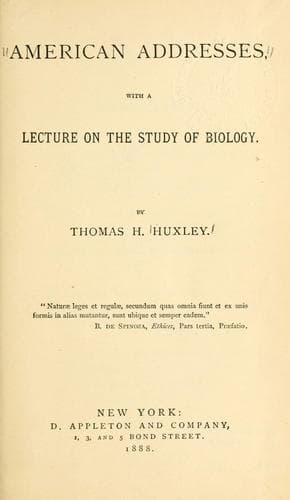
American Addresses, with a Lecture on the Study of BiologyHuxley, Thomas Henry
Science
American Addresses, with a Lecture on the Study of Biology
Huxley, Thomas Henry
Biology -- Study and teaching; Evolution; Johns Hopkins University
One would almost think this to be a self-evident proposition. I wonder
what a scholar would say to the man who should undertake to criticise a
difficult passage in a Greek play, but who obviously had not acquainted
himself with the rudiments of Greek grammar. And yet, before giving
positive opinions about these high questions of Biology, people not only
do not seem to think it necessary to be acquainted with the grammar of
the subject, but they have not even mastered the alphabet. You find
criticism and denunciation showered about by persons, who, not only have
not attempted to go through the discipline necessary to enable them to
be judges, but who have not even reached that stage of emergence from
ignorance in which the knowledge that such a discipline is necessary
dawns upon the mind. I have had to watch with some attention--in fact I
have been favoured with a good deal of it myself--the sort of criticism
with which biologists and biological teachings are visited. I am told
every now and then that there is a "brilliant article"[5] in so-and-so,
in which we are all demolished. I used to read these things once, but I
am getting old now, and I have ceased to attend very much to this cry of
"wolf." When one does read any of these productions, what one finds
generally, on the face of it, is that the brilliant critic is devoid of
even the elements of biological knowledge, and that his brilliancy is
like the light given out by the crackling of thorns under a pot of which
Solomon speaks. So far as I recollect, Solomon makes use of the image
for purposes of comparison; but I will not proceed further into that
matter.
Two things must be obvious: in the first place, that every man who has
the interests of truth at heart must earnestly desire that every
well-founded and just criticism that can be made should be made; but
that, in the second place, it is essential to anybody's being able to
benefit by criticism, that the critic should know what he is talking
about, and be in a position to form a mental image of the facts
symbolised by the words he uses. If not, it is as obvious in the case of
a biological argument, as it is in that of a historical or philological
discussion, that such criticism is a mere waste of time on the part of
its author, and wholly undeserving of attention on the part of those who
are criticised. Take it then as an illustration of the importance of
biological study, that thereby alone are men able to form something like
a rational conception of what constitutes valuable criticism of the
teachings of biologists.[6]
Public-domain text, read in full here on John Shaqi.
Reviews
Reviews
No reviews yet
Be the first to share your thoughts on this work.
Elsewhere in the archive
Join the Discussion
Join the discussion
Sign in to leave a comment or review.
Sign InorCreate an account