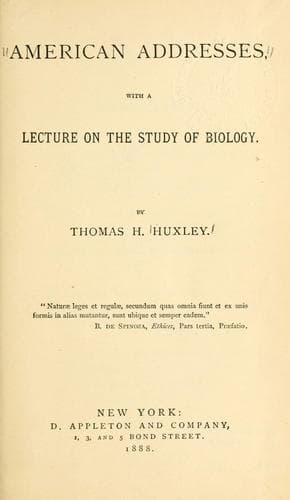
American Addresses, with a Lecture on the Study of BiologyHuxley, Thomas Henry
Science
American Addresses, with a Lecture on the Study of Biology
Huxley, Thomas Henry
Biology -- Study and teaching; Evolution; Johns Hopkins University
I might go on multiplying these examples, but I see that the clock won't
wait for me, and I must therefore pass to the third question to which I
referred: Granted that Biology is something worth studying, what is the
best way of studying it? Here I must point out that, since Biology is a
physical science, the method of studying it must needs be analogous to
that which is followed in the other physical sciences. It has now long
been recognised that, if a man wishes to be a chemist, it is not only
necessary that he should read chemical books and attend chemical
lectures, but that he should actually perform the fundamental
experiments in the laboratory for himself, and thus learn exactly what
the words which he finds in his books and hears from his teachers, mean.
If he does not do so, he may read till the crack of doom, but he will
never know much about chemistry. That is what every chemist will tell
you, and the physicist will do the same for his branch of science. The
great changes and improvements in physical and chemical scientific
education, which have taken place of late, have all resulted from the
combination of practical teaching with the reading of books and with the
hearing of lectures. The same thing is true in Biology. Nobody will ever
know anything about Biology except in a dilettante "paper-philosopher"
way, who contents himself with reading books on botany, zoology, and the
like; and the reason of this is simple and easy to understand. It is
that all language is merely symbolical of the things of which it treats;
the more complicated the things, the more bare is the symbol, and the
more its verbal definition requires to be supplemented by the
information derived directly from the handling, and the seeing, and the
touching of the thing symbolised:--that is really what is at the bottom
of the whole matter. It is plain common sense, as all truth, in the long
run, is only common sense clarified. If you want a man to be a tea
merchant, you don't tell him to read books about China or about tea, but
you put him into a tea-merchant's office where he has the handling, the
smelling, and the tasting of tea. Without the sort of knowledge which
can be gained only in this practical way, his exploits as a tea merchant
will soon come to a bankrupt termination. The "paper-philosophers" are
under the delusion that physical science can be mastered as literary
accomplishments are acquired, but unfortunately it is not so. You may
read any quantity of books, and you may be almost as ignorant as you
were at starting, if you don't have, at the back of your minds, the
change for words in definite images which can only be acquired through
the operation of your observing faculties on the phenomena of nature.
Public-domain text, read in full here on John Shaqi.
Reviews
Reviews
No reviews yet
Be the first to share your thoughts on this work.
Elsewhere in the archive
Join the Discussion
Join the discussion
Sign in to leave a comment or review.
Sign InorCreate an account