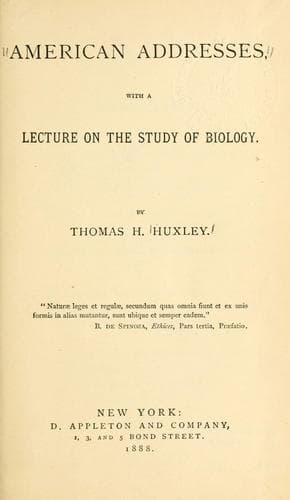
American Addresses, with a Lecture on the Study of BiologyHuxley, Thomas Henry
Science
American Addresses, with a Lecture on the Study of Biology
Huxley, Thomas Henry
Biology -- Study and teaching; Evolution; Johns Hopkins University
It may be said:--"That is all very well, but you told us just now that
there are probably something like a quarter of a million different kinds
of living and extinct animals and plants, and a human life could not
suffice for the examination of one-fiftieth part of all these." That is
true, but then comes the great convenience of the way things are
arranged; which is, that although there are these immense numbers of
different kinds of living things in existence, yet they are built up,
after all, upon marvellously few plans.
There are certainly more than 100,000 species of insects, and yet
anybody who knows one insect--if a properly chosen one--will be able to
have a very fair conception of the structure of the whole. I do not mean
to say he will know that structure thoroughly, or as well as it is
desirable he should know it; but he will have enough real knowledge to
enable him to understand what he reads, to have genuine images in his
mind of those structures which become so variously modified in all the
forms of insects he has not seen. In fact, there are such things as
types of form among animals and vegetables, and for the purpose of
getting a definite knowledge of what constitutes the leading
modifications of animal and plant life, it is not needful to examine
more than a comparatively small number of animals and plants.
Let me tell you what we do in the biological laboratory which is lodged
in a building adjacent to this. There I lecture to a class of students
daily for about four-and-a-half months, and my class have, of course,
their text-books; but the essential part of the whole teaching, and that
which I regard as really the most important part of it, is a laboratory
for practical work, which is simply a room with all the appliances
needed for ordinary dissection. We have tables properly arranged in
regard to light, microscopes, and dissecting instruments, and we work
through the structure of a certain number of animals and plants. As, for
example, among the plants, we take a yeast plant, a _Protococcus_, a
common mould, a _Chara_, a fern, and some flowering plant; among animals
we examine such things as an _Amoeba_, a _Vorticella_, and a
fresh-water polype. We dissect a star-fish, an earth-worm, a snail, a
squid, and a fresh-water mussel. We examine a lobster and a cray-fish,
and a black beetle. We go on to a common skate, a cod-fish, a frog, a
tortoise, a pigeon, and a rabbit, and that takes us about all the time
we have to give. The purpose of this course is not to make skilled
dissectors, but to give every student a clear and definite conception,
by means of sense-images, of the characteristic structure of each of the
leading modifications of the animal kingdom; and that is perfectly
possible, by going no further than the length of that list of forms
which I have enumerated. If a man knows the structure of the animals I
have mentioned, he has a clear and exact, however limited, apprehension
Public-domain text, read in full here on John Shaqi.
Reviews
Reviews
No reviews yet
Be the first to share your thoughts on this work.
Elsewhere in the archive
Join the Discussion
Join the discussion
Sign in to leave a comment or review.
Sign InorCreate an account