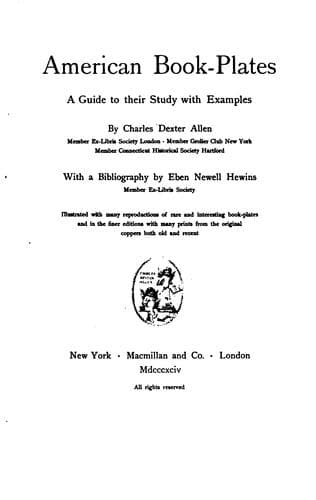
American Book-Plates: A Guide to Their Study with ExamplesAllen, Charles Dexter
History
American Book-Plates: A Guide to Their Study with Examples
Allen, Charles Dexter
Bookplates -- Bibliography; Bookplates, American
It is, however, to be admitted that at first glance, the general reader
who has not developed a special liking for the things of the past in
history, art, or biography, may see no especial interest in book-plates.
But let him examine a collection of good plates with their intelligent
owner, who can point out to him the facts worthy of note; let him once
understand that celebrated artists like Albrecht Durer, Jost Amman,
William Hogarth, William Marshall, George Vertue, Bewick, Bartolozzi,
and even Raphael Morghen were willing to devote time and taste to the
designing or engraving of the book-plate; let him handle some of their
work, and reflect upon the effort the master considered so small a
design worthy of; let him see the plates of some of the noted names in
history, art, letters, medicine, the sciences, and the professions; let
him take in his hands the plates of William Penn, the friend of the
Indian and benefactor of his race, of Laurence Sterne, of David Garrick,
of Horace Walpole, of Samuel Rogers, of Charles Dickens, or of George
Washington, of John Adams, and Charles Carroll, signers of the
Declaration; let him see a plate engraved by Paul Revere whose services
in the Revolution he has known of from his schooldays;--let him see
these and scores more of similar interest, and he cannot fail to respond
to the enthusiasm of their owner. But indeed it is a pursuit, the
delights of which are discernible to those only who bring to it the
capacity for such pleasures.
[Illustration: _John Adams._]
NAME-LABELS AND MOTTOES.
[Illustration: O]f all forms of book-plates the simplest possible is the
printed name of the owner, unaccompanied by either motto, device, or
ornamentation of any kind. Such a plate had _Philip Hone_, one of the
founders of the Mercantile Library, and in the early twenties a mayor of
the city of New York. His plate is merely a bit of paper with his name
in bold script printed upon it from an engraved copper-plate.
This style of plate is not chronologically the earliest, but is taken as
our starting-point because of its unrelieved simplicity; this fulfils
the mission of the book-plate,--it proclaims the ownership of the book
in which it is seen; not in delicate language, to be sure, not with any
invitation to dip into the volume in hand, not with any evidence of the
owner’s taste in reading, but with a directness not to be misunderstood.
The essential part of the book-plate is the name of the owner; and while
this is sufficient of itself, it is found profitable and pleasant to
accompany it with an apt quotation from a favorite author, with a
caution against the improper
[Illustration: James Eddy Mauran.]
Public-domain text, read in full here on John Shaqi.
Reviews
Reviews
No reviews yet
Be the first to share your thoughts on this work.
Join the Discussion
Join the discussion
Sign in to leave a comment or review.
Sign InorCreate an account