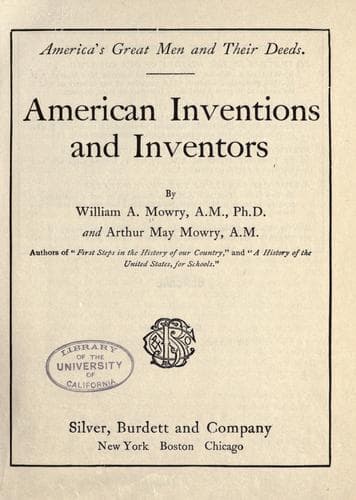
American Inventions and InventorsMowry, William A. (William Augustus)
History
American Inventions and Inventors
Mowry, William A. (William Augustus)
Inventions
As early as 1861 Moses G. Farmer introduced a successful method of
signaling which afterward was employed by the officers of the United
States Coast Survey on Lake Superior. This system was by means of
mirrors which were able to reflect the sunlight between stations
ninety miles apart. This method is called the heliographic system. The
French have used it among the islands of the Indian Ocean where the
stations are on mountain peaks sometimes 135 miles apart. Even this
long-range signaling has been surpassed by our own Signal Corps, which
has succeeded in sending messages by our method from Mount Uncompahgre
in Colorado to Mount Ellen in Utah, a distance of 183 miles. During the
siege of Paris, messages by the use of the calcium light, concentrated
and directed by lenses, were sent from one point to another.
A very unique form of signaling was employed by New York State at the
opening of the Erie Canal, in 1825. The cannon, which had been captured
by Commodore Perry at the time of his famous victory on Lake Erie, were
placed at intervals along the line of the canal. When the first canal
boat started from Buffalo, the first cannon was fired. When the sound
was heard at the second cannon, that was discharged; and so on, the
entire length of the canal. Two hours after the start at Buffalo the
news had reached New York.
All these various methods of communication at long range have proved
more or less objectionable and unsatisfactory. It was natural,
therefore, that as soon as it was known that electricity could be
conducted by wires from one place to another, experiments should
be begun in the hope of finding some possible means of conveying
intelligence by it. Perhaps the earliest suggestion was in a letter
published in _The Scots Magazine_, of February, 1753. The letter was
signed "C. M.", which probably meant Charles Morrison, a young Scotch
surgeon. He proposed to use as many insulated conductors as there
were letters in the alphabet. Each wire was to represent one letter
only, and the message would be sent by charging the several wires
in succession so that the operator in receiving it would be obliged
to notice the order of movement among the wires. From that simple
beginning inventors proceeded to suggest first one thing and then
another, but they found so many difficulties that it seemed impossible
to overcome them all.
CHAPTER V.
THE TELEGRAPH.
[Illustration: ELECTRIC WIRES.]
Public-domain text, read in full here on John Shaqi.
Reviews
Reviews
No reviews yet
Be the first to share your thoughts on this work.
Elsewhere in the archive
Join the Discussion
Join the discussion
Sign in to leave a comment or review.
Sign InorCreate an account