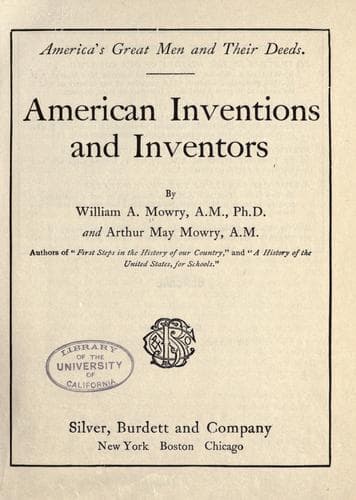
American Inventions and InventorsMowry, William A. (William Augustus)
History
American Inventions and Inventors
Mowry, William A. (William Augustus)
Inventions
On the second day of April, 1872, in the city of New York, the life of
a benefactor of his race, an aged man who had seen more than fourscore
years of mingled trial and triumph, was ended. That man was Prof.
Samuel Finley Breese Morse, the inventor of the electric telegraph.
His name is as widely known the world over as that of Washington,
or Cæsar, or Aristotle. His long life had been extremely checkered.
He had passed through troubles, trials, anxieties, disappointments,
bereavements; he had been subject to persecutions, losses, poverty,
toil, discouragements; he had met with successes, gains, wealth,
luxury, honors, fame; and finally the homage of republics, kingdoms,
empires had been laid at his feet. He was never cast down, never unduly
elated. He bore all his poverty and disappointments and wore all his
honors and wealth with the "grace of a Christian and the calmness of a
philosopher."
Professor Morse was born at the foot of Breed's Hill in Charlestown,
Massachusetts, April 27th, 1791. He was the oldest of three brothers.
His father was a very distinguished man in his day; for more than
thirty years the pastor of a church in Charlestown, a noted preacher,
a good historian, the author of many books, and, particularly, the
father of the science of geography in the United States. Professor
Morse inherited from both his father and his mother those traits of
character which enabled him to succeed in his great life work, in spite
of discouragements, obstacles, and opposition. His ancestors were all
noted for their "intelligence, energy, original thinking, perseverance,
and integrity."
How we would like to step into the little schoolroom and see Samuel
at his first school. He was four years of age. His teacher was known
as "Old Ma'am Rand," an invalid who could not leave her chair. She
governed the uneasy little urchins with a long rattan that would reach
across the small room where she kept her school. At seven years of age
Samuel was sent to Andover to a preparatory school, kept by Mr. Foster;
here he fitted for Phillips Academy and, in that famous institution,
under the direction of Mark Newman, he prepared for Yale College, where
he was graduated in 1810.
While in college he was under the instruction of Jeremiah Day in
natural philosophy and paid great attention to the subject of
electricity, getting everything that was known about it at that time.
Professor Day said: "Morse was often present in my laboratory during my
preparatory arrangements and experiments, and thus was made acquainted
with them." On leaving college Morse had a burning ambition to be a
portrait painter. He put himself under the instruction of Washington
Allston, and went with him to England to pursue his favorite study.
Is it not a little singular that Morse, who invented the telegraph,
was a student under Allston, and that Robert Fulton, who invented the
American steamboat, was a student under West, another famous American
painter?
Public-domain text, read in full here on John Shaqi.
Reviews
Reviews
No reviews yet
Be the first to share your thoughts on this work.
Elsewhere in the archive
Join the Discussion
Join the discussion
Sign in to leave a comment or review.
Sign InorCreate an account