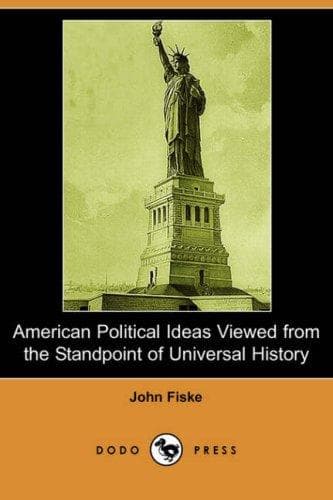
American Political Ideas Viewed from the Standpoint of Universal History — John Shaqi
American Political Ideas Viewed from the Standpoint of Universal HistoryFiske, John
Philosophy
American Political Ideas Viewed from the Standpoint of Universal History
Fiske, John
United States -- History -- Philosophy; United States -- Politics and government
for "town-meeting." In the shires where the Danes acquired a firm
foothold, the township was often called a "by"; and it had the power of
enacting its own "by-laws" or town-laws, as New England townships have
to-day. But above all, the assembly of the markmen has left vestiges of
itself in the constitution of the parish and the manor. The mark or
township, transformed by the process of feudalization, becomes the
manor. The process of feudalization, throughout western Europe in
general, was no doubt begun by the institution of Benefices, or "grants
of Roman provincial land by the chieftains of the" Teutonic "tribes
which overran the Roman Empire; such grants being conferred on their
associates upon certain conditions, of which the commonest was military
service." [6] The feudal régime naturally reached its most complete
development in France, which affords the most perfect example of a Roman
territory overrun and permanently held in possession by Teutonic
conquerors. Other causes assisted the process, the most potent perhaps
being the chaotic condition of European society during the break-up of
the Carolingian Empire and the Scandinavian and Hungarian invasions.
Land was better protected when held of a powerful chieftain than when
held in one's own right; and hence the practice of commendation, by
which free allodial proprietors were transformed into the tenants of a
lord, became fashionable and was gradually extended to all kinds of
estates. In England the effects of feudalization were different from
what they were in France, but the process was still carried very far,
especially under the Norman kings. The theory grew up that all the
public land in the kingdom was the king's waste, and that all
landholders were the king's tenants. Similarly in every township the
common land was the lord's waste and the landholders were the lord's
tenants. Thus the township became transformed into the manor. Yet even
by such a change as this the townsmen or tenants of the manor did not in
England lose their self-government. "The encroachments of the lord," as
Sir Henry Maine observes, "were in proportion to the want of certainty
in the rights of the community." The lord's proprietorship gave him no
authority to disturb customary rights. The old township-assembly
partially survived in the Court Baron, Court Leet, and Customary Court
of the Manor; and in these courts the arrangements for the common
husbandry were determined.
Public-domain text, read in full here on John Shaqi.
Reviews
Reviews
No reviews yet
Be the first to share your thoughts on this work.
Join the Discussion
Join the discussion
Sign in to leave a comment or review.
Sign InorCreate an account