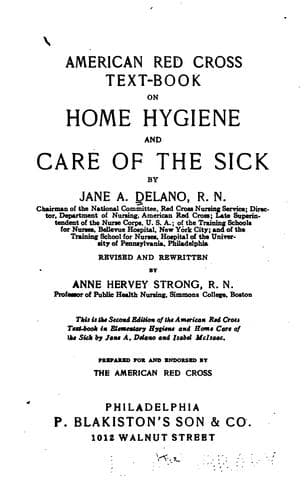
American Red Cross Text-Book on Home Hygiene and Care of the SickAmerican National Red Cross
Science
American Red Cross Text-Book on Home Hygiene and Care of the Sick
American National Red Cross
Home nursing; Hygiene; Nurses; Nursing
A small bottle of tincture of iodine and one of 70% alcohol should be
kept for disinfecting. Neither one is for internal use. The iodine is
used to disinfect small wounds and abrasions of the skin. It is applied
with cotton swabs and several swabs should be made and kept on hand in a
box or envelope. Alcohol is used to disinfect thermometers and other
instruments that cannot be boiled, for rubbing, and may also be used for
disinfecting the skin. A 90% solution is sometimes used for rubbing; it
need not be bought until needed. Denatured and wood alcohol are poisons
and should be used in households only in spirit lamps; they are not safe
for other purposes.
First aid materials may include two gauze bandages two and one-half
inches wide and two bandages one inch wide, one American Red Cross First
Aid Outfit, a small package of absorbent cotton, a roll of old muslin, a
package of adhesive plaster one inch wide, boracic ointment, picric acid
gauze or other application for burns, safety pins, and a pair of
scissors.
For use in cases of fainting or exhaustion it is well to keep aromatic
spirits of ammonia on hand. Its bottle should have a rubber stopper. The
dose is one-half to one teaspoonful, in a quarter to half a glass of
water. Hot coffee and tea are also good stimulants, but the time
necessary to prepare them makes it desirable to have aromatic ammonia
on hand. Household or ordinary ammonia must not be used as a substitute.
Olive oil, mustard, and baking soda may be brought from the kitchen when
needed. It is assumed that vaseline, cold cream, hand lotion, talcum
powder, and other toilet preparations will also be available.
Only a few appliances are necessary. Among them are a medicine glass, a
teaspoon, clinical thermometer, hot water bag, fountain syringe, and an
alcohol lamp in houses without gas or electric stoves. It is better not
to buy other appliances until they are needed, particularly rubber goods
since they deteriorate rapidly.
EXERCISES
1. Why is it dangerous for persons without medical training to prescribe
medicines? What is the especial danger of dosing oneself?
2. What is meant by a habit-forming drug? Name all you can, and tell why
they are peculiarly dangerous.
3. What are the special objections to patent medicines?
4. What precautions should be taken in order to administer medicine
accurately? What precautions to avoid giving wrong medicines?
5. How may some disagreeable medicines be made more palatable?
6. Tell how to prepare and give a soapsuds enema.
7. How should a fountain syringe be cared for? a throat spray?
8. Describe methods for giving steam inhalations.
9. Describe the equipment and care of a household medicine cupboard.
10. What drugs is it well for a family to keep on hand? What appliances?
What materials for first aid?
Public-domain text, read in full here on John Shaqi.
Reviews
Reviews
No reviews yet
Be the first to share your thoughts on this work.
Elsewhere in the archive
Join the Discussion
Join the discussion
Sign in to leave a comment or review.
Sign InorCreate an account