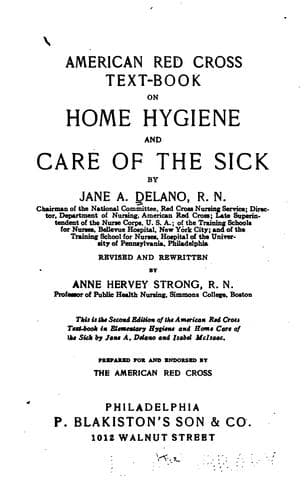
American Red Cross Text-Book on Home Hygiene and Care of the SickAmerican National Red Cross
Science
American Red Cross Text-Book on Home Hygiene and Care of the Sick
American National Red Cross
Home nursing; Hygiene; Nurses; Nursing
DRY COLD.--Cold, like heat, may be used either dry or moist. Bags of
rubber or of Japanese paper filled with small pieces of ice are used to
apply dry cold. When weight is to be avoided, the bag should not be
completely filled. After the bag has been filled and the air has been
expelled, it should be stoppered securely and wrapped in a towel or
piece of flannel, since it is possible for an uncovered ice bag to
freeze the skin. Ice bags are easily punctured, and care should be taken
not to bring pressure upon them especially when filled with sharp pieces
of ice. An ice bag not in use should be thoroughly dry inside and out;
it should be put away with enough absorbent cotton inside to keep the
surfaces from adhering. Bags of Japanese paper are less costly than
rubber, but less durable. To close them one should roll the top over and
then tie it tightly with string.
MOIST COLD.--Cold compresses for the head are often used for patients
with fever or headache; they sometimes quiet a patient who is restless.
An old handkerchief or piece of soft linen folded with the raw edges
inside may be used as a compress. It should be large enough to cover the
forehead. Two compresses at least should be provided, and a large piece
of ice in a basin. One compress should be wrung so that it will not
drip, and then applied to the head. The other meanwhile should be placed
on the ice to cool. As soon as the first compress becomes warm, the
second should be applied in its place.
_Cold Compresses for the Eyes._--Soft material should be selected for
eye compresses. Each one should be cut only a little larger than the eye
and should fit neatly over it. Several compresses should be placed on a
block of ice while one is applied to the eye, and every few minutes the
compress should be changed. If there is discharge from the eye, each
compress should be used but once; when used, they should be collected in
a paper and afterward burned. Separate compresses should be used if both
eyes are being treated. Definite directions in regard to changing
compresses and the length of time the applications should be continued
are generally given by the physician.
COUNTER-IRRITANTS
To some extent all hot applications are counter-irritants, but mustard
pastes, mustard leaves, and the mustard foot-bath already described are
the counter-irritants most commonly used.
Public-domain text, read in full here on John Shaqi.
Reviews
Reviews
No reviews yet
Be the first to share your thoughts on this work.
Elsewhere in the archive
Join the Discussion
Join the discussion
Sign in to leave a comment or review.
Sign InorCreate an account