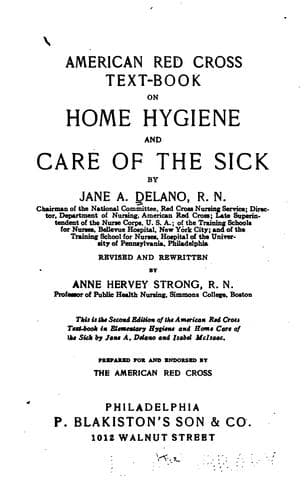
American Red Cross Text-Book on Home Hygiene and Care of the SickAmerican National Red Cross
Science
American Red Cross Text-Book on Home Hygiene and Care of the Sick
American National Red Cross
Home nursing; Hygiene; Nurses; Nursing
_Mustard Paste._--To make a mustard paste, mix dry mustard with flour,
using for adults one part of mustard and six of flour to make a weak
paste; increase the proportion of mustard up to equal parts of mustard
and flour, according to the strength required. Use a smaller proportion
of mustard for children; one part of mustard with from 6 to 10 parts of
flour is generally enough. Add to the mustard and flour enough tepid
water to make a paste, which must be absolutely free from lumps. Do not
use hot water for this purpose, because it destroys some of the active
properties of the mustard. Spread the paste on thin muslin, apply it to
the skin, and remove it as soon as the skin is reddened so that its
color resembles that of a strong sun-burn. If the skin is especially
sensitive, mix a little sweet oil or vaseline with the paste.
_Mustard leaves_ should be dipped in tepid water and may then be applied
to the skin directly, but if specially sensitive, the skin should be
protected by thin muslin or gauze. The leaf should remain until the skin
is well reddened; a few minutes are generally sufficient.
Care must be taken not to leave either a mustard leaf or a paste in
place long enough to blister the skin. After the application has been
removed; the part should be protected by a soft cloth until redness
disappears. Vaseline or sweet oil should be applied to the skin if it is
greatly irritated.
Other counter-irritants in common use are iodine, turpentine, ammonia,
kerosene, camphorated oil, capsicum vaseline, and various liniments.
Tincture of iodine may be diluted with alcohol for especially sensitive
skins; it sometimes causes blisters, and should not be applied more than
once a day at most. Ammonia and turpentine cause blisters; they should
not be used as counter-irritants except by a doctor's order, and then
only after exact directions have been obtained. Turpentine and kerosene
are inflammable and hence dangerous to use. It should be remembered that
the action of all counter-irritants is physiologically the same, so that
no advantage is obtained from the use of dangerous substances like
kerosene and turpentine.
EXERCISES
1. What are the causes and symptoms of inflammation?
2. Describe the process of inflammation.
3. What is the effect of heat on an inflamed area? of cold?
4. What are the dangers from hot applications, and how may they be
guarded against?
5. How should you fill a hot water bag? How should you cover it?
6. Describe the method of preparing and applying a flaxseed poultice.
7. Tell how to prepare and apply fomentations.
8. How should you apply cold compresses to the head? to the eyes?
9. How should you make a mustard paste for a baby six months old? for a
grown person only slightly ill? for a feeble old person with a sensitive
skin?
FOR FURTHER READING
Essentials of Medicine--Emerson, Chapter I.
The Human Mechanism--Hough and Sedgwick, Chapter IX.
CHAPTER XII
CARE OF PATIENTS WITH COMMUNICABLE DISEASES
Public-domain text, read in full here on John Shaqi.
Reviews
Reviews
No reviews yet
Be the first to share your thoughts on this work.
Elsewhere in the archive
Join the Discussion
Join the discussion
Sign in to leave a comment or review.
Sign InorCreate an account