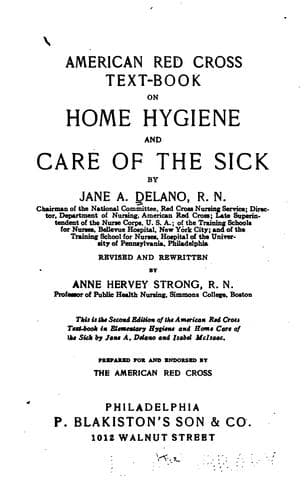
American Red Cross Text-Book on Home Hygiene and Care of the SickAmerican National Red Cross
Science
American Red Cross Text-Book on Home Hygiene and Care of the Sick
American National Red Cross
Home nursing; Hygiene; Nurses; Nursing
The first chapter of this book described the ways in which communicable
diseases are carried from person to person, and also some principles
underlying methods of prevention. This chapter aims to show how these
principles apply in the actual care of patients whose diseases are
transmissible. In order to apply them intelligently, it is necessary to
keep in mind certain facts in regard to the transmission of infections.
A brief summary of these facts follows.
Disease germs are present in the bodies of persons suffering from
communicable disease, but they may also exist in the bodies of persons
in good health; if present in the body, they may leave it in any bodily
discharge. While every kind of germ does not leave the body by all the
different routes, it is nevertheless true that most germs expelled from
the body are carried in discharges from the nose, throat, bladder or
bowels. Germ-laden discharges of an infected person may be distributed
to other persons by water, milk and other foods, by certain insects, by
unclean hands, by common drinking cups, towels, handkerchiefs, and
similar articles, and directly by nose and throat spray. After they have
been thus conveyed to other persons, the germs make their entrance into
the body of their new victims through the digestive tract, through the
nose, throat, and other mucous membranes, or through breaks in the skin.
Prevention of communicable diseases, therefore, depends upon the measure
of success attained in blocking the transit of germs from person to
person; but methods of prevention, though easy to understand, are
unfortunately sometimes difficult to carry out. In order to carry them
out effectively one must devote to the problem great accuracy,
unremitting care, considerable intelligence, and a highly developed
conscience.
Care of a patient suffering from transmissible disease is adequate only
when it accomplishes two definite results. One result, which concerns
the patient primarily, is to bring about his recovery as rapidly and as
surely as possible; the other result, which concerns the community
rather than the individual, is to make it impossible for the patient to
infect others with his disease. In every case of communicable disease,
from a slight cold in the head up to serious cases of pneumonia or
typhoid fever, both the patient and the community must be constantly
safe-guarded.
INCUBATION PERIOD.--The interval between the moment when pathogenic
germs enter the body, and the time when symptoms first appear and the
patient begins to feel ill, is called the incubation period. Incubation
periods vary according to the disease from a few hours to two or three
weeks. The length of the period also varies somewhat in different cases
of the same disease.
Public-domain text, read in full here on John Shaqi.
Reviews
Reviews
No reviews yet
Be the first to share your thoughts on this work.
Elsewhere in the archive
Join the Discussion
Join the discussion
Sign in to leave a comment or review.
Sign InorCreate an account