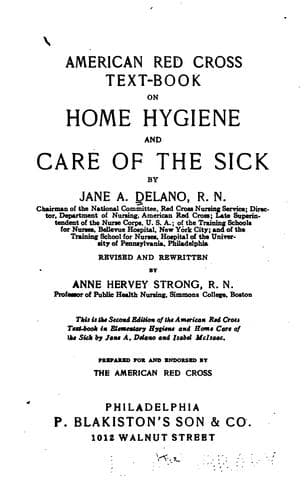
American Red Cross Text-Book on Home Hygiene and Care of the SickAmerican National Red Cross
Science
American Red Cross Text-Book on Home Hygiene and Care of the Sick
American National Red Cross
Home nursing; Hygiene; Nurses; Nursing
Even during slight illness a patient should receive the daily care
already described, and should be made as comfortable as possible. As in
any illness, sponging and alcohol rubs are refreshing. An ice bag or
cold compress may relieve headache, and hot applications or a cold
compress on the throat are often soothing. The throat may be gargled
with a solution of one teaspoonful of common salt dissolved in a pint of
boiled water. If the patient perspires profusely he should be rubbed
with a towel until dry, and provided with fresh warm, night clothes. An
alcohol rub may well follow. It is most unwise for a patient who is
perspiring freely to get up in a cold room and attend to himself.
Common colds are far more serious than they are usually supposed to be.
"More people suffer from common colds than from any other
single ailment.... Could the sum total of suffering,
inconvenience, sequelæ, and economic loss resulting from
common colds be obtained, it would at once promote these
infections from the trivial into the rank of the serious
diseases.... Colds are contracted from other persons having
colds, just as diphtheria is contracted from diphtheria.
Arctic explorers exposed to all the conditions ordinarily
supposed to produce colds do not suffer from these ailments
until they return to civilization and become infected by
contact with their fellowmen.... While common colds are
never fatal, the complications and sequelæ are serious.
These are rheumatic fever, pneumonia, sinusitis, nephritis,
and a depressed vitality which favors other infections and
hastens the progress of organic diseases.
"Common colds are perhaps most contagious during the early
stages. If persons isolate themselves by remaining in bed
during the first three days of a cold, they would not only
benefit themselves, but would largely prevent the spread of
the infection. The contagiousness and severity of colds
differ in different epidemics and in different seasons of
the year, depending upon the particular micro-organism
involved and other factors not well understood.
"PREVENTION.--The prevention of colds consists, first in
avoiding the infection, and, secondly, in guarding against
the predisposing causes. Contact should be avoided with
persons who have colds, especially in street cars, offices,
and other poorly ventilated spaces where the risk of
persons coughing or sneezing directly in one's face is
imminent. Contact with the infection may further be guarded
against by a careful self-education in sanitary habits and
cleanliness, based upon the modern conception of contact
infection.
Public-domain text, read in full here on John Shaqi.
Reviews
Reviews
No reviews yet
Be the first to share your thoughts on this work.
Elsewhere in the archive
Join the Discussion
Join the discussion
Sign in to leave a comment or review.
Sign InorCreate an account