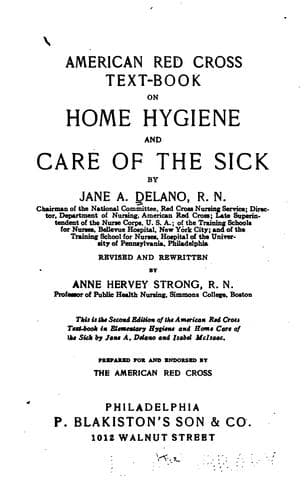
American Red Cross Text-Book on Home Hygiene and Care of the SickAmerican National Red Cross
Science
American Red Cross Text-Book on Home Hygiene and Care of the Sick
American National Red Cross
Home nursing; Hygiene; Nurses; Nursing
"Colds, like other diseases conveyed in the secretions from
the nose and mouth, are often conveyed by direct and
indirect contact through lack of hygienic cleanliness and a
disregard of sanitary habits. Kissing, the common drinking
cup, the roller towel, pipes, toys, pencils, fingers, food,
and other objects contaminated with the fresh secretions
will transmit the disease."--("Preventive Medicine and
Hygiene," Rosenau.)
CARE DURING MORE SERIOUS INFECTIONS.--When a patient is suffering from
serious transmissible disease, he needs the most skillful care
available, and for the sake of others he must be strictly isolated or
quarantined. By isolating or quarantining a patient is meant making such
arrangements that germs expelled by the patient are necessarily
destroyed before they can enter the body of another person. Isolation,
therefore, includes disinfection, and while methods vary according to
the nature of the particular disease, yet the principles given below are
applicable in most cases.
The first essential is that the patient should have a room to himself.
No one except those caring for him should enter the sick-room for any
purpose whatever; visitors should be rigidly excluded. At the outset all
unnecessary articles should be removed from the sick-room, and it
should be possible to boil, burn, scrub, or otherwise thoroughly clean
everything allowed to remain. The windows should be screened in summer,
and flies must be excluded. Fresh air is especially needed by patients
with communicable diseases, and ventilation of the room must be adequate
both day and night. Foul odors plainly indicate that the patient or
something in the room is not clean. The remedy is obvious and deodorants
are quite unnecessary if the patient and the room are properly cared
for. It is highly desirable to reserve a bath room for the exclusive use
of the patient and his attendant and also to reserve a room adjoining
the patient's room for the exclusive use of the attendant. When it is
impossible, as it often is, to give up so much space, each family must
make the best arrangement it can to separate the patient and his
attendant from the rest of the family.
The attendant must remember that her ten fingers are the ten most active
agents in distributing the communicable diseases. After handling the
patient or anything that the patient has touched, and whenever she
leaves the patient's room, she must scrub her hands thoroughly with warm
water, soap, and a nail brush. She should not soil her hands
unnecessarily, even though she intends to scrub them later. She must
remember for her own protection to keep her hands away from her mouth
and face, and to cleanse them with special care just before eating. If
disinfection is needed in addition to the scrubbing, she must use
conscientiously whatever solution the doctor orders.
Public-domain text, read in full here on John Shaqi.
Reviews
Reviews
No reviews yet
Be the first to share your thoughts on this work.
Elsewhere in the archive
Join the Discussion
Join the discussion
Sign in to leave a comment or review.
Sign InorCreate an account