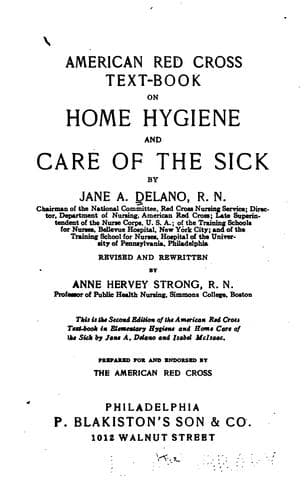
American Red Cross Text-Book on Home Hygiene and Care of the SickAmerican National Red Cross
Science
American Red Cross Text-Book on Home Hygiene and Care of the Sick
American National Red Cross
Home nursing; Hygiene; Nurses; Nursing
THE CHILDREN'S DISEASES.--The so-called children's diseases are probably
the most familiar and the least regarded of all those belonging to the
communicable group. Most persons, it is true, realize that scarlet fever
is serious; everyone should also realize that measles and whooping-cough
are serious. For example, in the State of New York during the year 1916,
more children died from each of these diseases than from scarlet fever:
in that year 745, or four times the number that died of scarlet fever,
lost their lives from whooping-cough, while 913 died of measles. If
diseases that kill hundreds of children every year are not serious, one
is at a loss to know what a serious disease is.
Some parents even expose children unnecessarily to these infections on
the fatalistic theory that they must have the diseases sometime, and
therefore the sooner the better. Nothing could be more mistaken; the
diseases are not inevitable, and there is no advantage whatever in
having them if escape is possible. Moreover, serious as the children's
diseases are in themselves, their after-effects may be even more
serious. At this very moment hundreds of people are going through
life handicapped by weakened hearts or kidneys, by defective sight or
hearing, merely because their parents considered the children's diseases
necessary. The common belief that children should have these diseases as
early as possible is also erroneous, since statistics show that the
younger the child the more likely is the disease to prove fatal.
Every mother should realize that the children's diseases are most
infectious in the early stages. Early symptoms include fever, sore
throat, and nasal discharge, and the trouble at first often resembles a
severe cold. During this stage the diseases are most easily
communicated. Measles in particular is generally not recognized until
its most infectious stage has passed. The moral to be drawn is that sore
throats, coughs, and colds should never be regarded lightly, and that
their spread should be prevented by all possible means.
The accompanying table taken from the regulations of the New York State
Department of Health, gives symptoms of communicable diseases among
children, and rules for isolation and exclusion from school.
NEW YORK STATE DEPARTMENT OF HEALTH
COMMUNICABLE DISEASES AMONG CHILDREN
RULES FOR ISOLATION AND EXCLUSION FROM SCHOOL
HERMAN M. BIGGS, M.D.
Commissioner
Issued by the
Division of Public Health Education
Public-domain text, read in full here on John Shaqi.
Reviews
Reviews
No reviews yet
Be the first to share your thoughts on this work.
Elsewhere in the archive
Join the Discussion
Join the discussion
Sign in to leave a comment or review.
Sign InorCreate an account