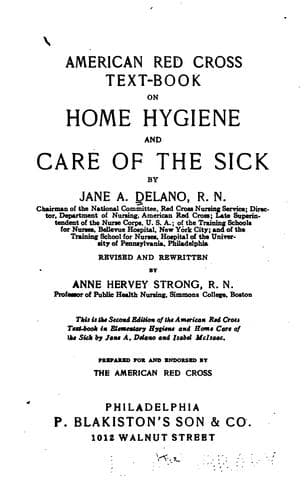
American Red Cross Text-Book on Home Hygiene and Care of the SickAmerican National Red Cross
Science
American Red Cross Text-Book on Home Hygiene and Care of the Sick
American National Red Cross
Home nursing; Hygiene; Nurses; Nursing
At the same time that she is caring for a patient with a communicable
disease, the attendant ought not to care for children or other members
of the family, she ought not to prepare food, and she ought not to
handle dishes or utensils used by other persons. Every day, however,
many women are doing just these things, and it is true that in many
instances no bad results are observed. Yet if any arrangement to insure
safety can possibly be made, it is inexcusable to run the risk of
spreading diseases which kill thousands of persons every year and injure
many more for life.
When home conditions render adequate care and strict isolation of the
patient impossible, hospital care should be seriously considered. No
personal or sentimental objections should be allowed to influence the
decision, if removing the patient to a hospital is necessary to
safeguard his welfare or the welfare of the family. Hospital care should
be considered especially for patients with typhoid fever, because
untrained persons cannot safely care for patients so seriously ill.
Since a patient with typhoid needs skilled care, and since he greatly
endangers other persons, most authorities consider hospital care
essential unless the patient can have the continuous services of a
trained nurse and almost ideal home conditions. Many cases of typhoid,
it is true, are successfully nursed at home in extremely adverse
conditions by visiting nurses; yet in few kinds of sickness is
continuous care by a graduate nurse more necessary to protect the
community as well as to safeguard the patient himself.
Members of a family in which there is typhoid should be immunized if the
doctor advises it. This process, which is performed by the doctor, in
the majority of cases renders a person immune to typhoid fever for three
or four years.
The question of home or institutional care for persons with tuberculosis
must also be carefully considered. In some cases tuberculosis may be
cared for at home with comparative safety, and in some other cases the
risk is not very great if the patient is intelligent, careful, and well
supervised. But everyone should face the fact that all cases of
tuberculosis of the lungs involve some risk to others in the family, and
most cases involve great risk. The danger to children is greater than to
adults. Most tuberculosis infections, it is now believed, are acquired
in childhood. The bad results of an infection acquired in childhood may
not show themselves for years, since the germs may remain inactive until
the person's resistance is lowered by some unfavorable condition.
Public-domain text, read in full here on John Shaqi.
Reviews
Reviews
No reviews yet
Be the first to share your thoughts on this work.
Elsewhere in the archive
Join the Discussion
Join the discussion
Sign in to leave a comment or review.
Sign InorCreate an account