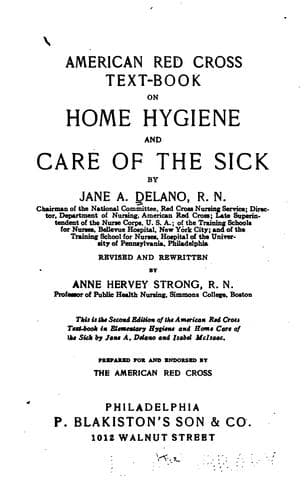
American Red Cross Text-Book on Home Hygiene and Care of the SickAmerican National Red Cross
Science
American Red Cross Text-Book on Home Hygiene and Care of the Sick
American National Red Cross
Home nursing; Hygiene; Nurses; Nursing
FUMIGATION.--Many Boards of Health have abandoned fumigation after
communicable diseases, except after those which like typhus and yellow
fever, are carried by vermin or insects. Dry formaldehyde gas, which was
formerly used for fumigation, has a violent effect on mucous membranes,
but its power to kill bacteria, even on surfaces, appears to be weak,
while its penetrating power is not sufficient to disinfect bedding,
carpets, upholstered furniture, and other fabrics. Since fumigation is
costly, troublesome, and ineffectual there seems to be no good reason
for using it. Moreover, its use gives a false sense of security, so that
really effective measures like sunning, airing, and scrubbing are likely
to be neglected.
Theory and practice of disinfection, it is clear, have radically
changed in recent years. Modern knowledge requires concurrent
disinfection, or the destruction of germs from the moment when symptoms
are first noticed; all the time, day and night, this disinfection must
go on with unremitting care. Today wet sheets are not hung in doorways
nor are chemicals left about in open dishes to disinfect quite harmless
air, but scrupulous cleanliness at all stages of disease is recognized
as one of the most important measures, if not the most important
measure, in disinfection.
EXERCISES
1. Summarize the ways in which infectious diseases are spread.
2. What is meant by the incubation period? State the length of the
incubation period in measles; Liberty measles; whooping-cough; scarlet
fever; chicken-pox; diphtheria; mumps; typhoid fever.
3. Name some of the early symptoms common to most infectious diseases.
If such symptoms appear, what should be done while waiting for the
doctor to come?
4. Discuss the importance, prevention, and treatment of common colds.
5. What measures should be taken to isolate a patient who is suffering
from a communicable disease?
6. What special care should the attendant of a patient with a
communicable disease give to her own clothing and person?
7. Why are the children's diseases more serious in reality than they are
commonly supposed to be?
8. Describe the symptoms of each of the following: Measles, scarlet
fever, chicken-pox, mumps, whooping-cough, and diphtheria.
9. How should bowel and bladder discharges be disinfected?
10. How should dishes and other utensils be disinfected?
11. How should linen be disinfected?
12. Describe measures necessary for concurrent disinfection.
13. Describe measures necessary for terminal disinfection.
FOR FURTHER READING
Preventive Medicine and Hygiene--Rosenau.
The New Public Health--Hill, Chapters VII-XVII.
Essentials of Medicine--Emerson, Chapters XII-XV.
Health and Disease--Roger I. Lee, Chapter X-XIV.
Disease and Its Causes--Councilman, Chapters V-IX.
Public-domain text, read in full here on John Shaqi.
Reviews
Reviews
No reviews yet
Be the first to share your thoughts on this work.
Elsewhere in the archive
Join the Discussion
Join the discussion
Sign in to leave a comment or review.
Sign InorCreate an account