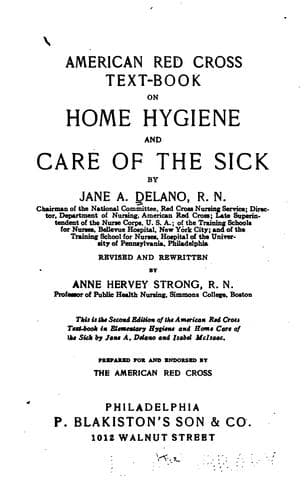
American Red Cross Text-Book on Home Hygiene and Care of the SickAmerican National Red Cross
Science
American Red Cross Text-Book on Home Hygiene and Care of the Sick
American National Red Cross
Home nursing; Hygiene; Nurses; Nursing
DISORDERS AFFECTING THE EARS.--Permanent deafness may result from
neglecting disorders of the ears. Ear-ache, discharge from the ear,
swelling in or about it, pain or tenderness behind it, all require
medical attention and no time should be lost in securing it. To relieve
pain the patient may lie with the ear on an ice bag, but nothing
whatever should be put into the ear before the doctor comes, except when
an insect has entered the ear, and causes acute distress by the noise of
its beating wings. If such an accident has occurred, the patient should
lie on the unaffected side, and warm sweet oil should be dropped very
gently into the affected ear by means of a medicine dropper. The insect
generally drowns in the oil and floats to the opening of the ear canal.
After it has been removed, the patient should lie on the affected side
so that the oil may drain out of the ear.
No attempts should be made to remove foreign bodies from the ear or
nose, unless they can be reached easily with the fingers. Hair pins,
crochet hooks and similar instruments should never be used for this
purpose. It is best for a doctor to remove foreign objects because
unskillful attempts are likely to move them further in.
CONDITIONS IN WHICH THE SKIN IS AFFECTED
PRICKLY-HEAT, which affects babies and children more often than adults,
is an eruption caused by heat and moisture, and aggravated by flannel
underwear. It may be prevented by keeping the skin dry and cool, and it
may be relieved by bathing the skin with alcohol and water, about one
part of alcohol to three of water, and by using after the bath a powder
made of two parts of starch to one of boracic acid, or any good talcum
powder.
INSECT BITES AND STINGS.--The sting, if still in the wound, should first
be removed, and then ammonia should be applied, since the poison is
generally acid. Applications of cold water, alcohol and water, or wet
salt may relieve the subsequent burning and itching, but ammonia is
generally most effective.
IVY POISONING may be treated by applying cloths wet in a strong solution
of baking soda or of boracic acid, or by applications of carbolized
vaseline or ichthyol. Severe cases should have medical attention.
Scratching and rubbing seem to spread the inflammation, and special care
should be taken not to rub the face or eyes with infected hands.
Susceptible people should avoid the plant if possible.
OTHER EMERGENCIES
CHILLS may be the result of infection or of exposure to cold. An early
diagnosis of the trouble is so desirable that it is well to send for a
doctor even when symptoms are not severe. If a person has a chill his
temperature should be taken at once; fever and chill together probably
indicate invasion by bacteria. When chills follow exposure to cold the
patient should go to bed between warm blankets, his body should be
briskly rubbed, and hot water bags and a hot drink should be given. If
he prefers, he may take a hot bath before going to bed.
Public-domain text, read in full here on John Shaqi.
Reviews
Reviews
No reviews yet
Be the first to share your thoughts on this work.
Elsewhere in the archive
Join the Discussion
Join the discussion
Sign in to leave a comment or review.
Sign InorCreate an account