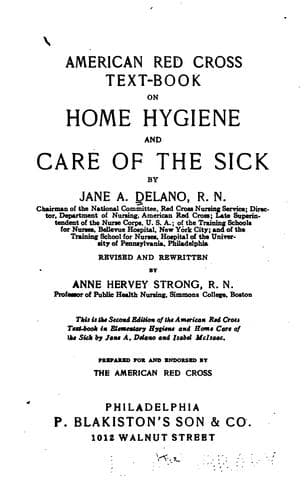
American Red Cross Text-Book on Home Hygiene and Care of the SickAmerican National Red Cross
Science
American Red Cross Text-Book on Home Hygiene and Care of the Sick
American National Red Cross
Home nursing; Hygiene; Nurses; Nursing
CROUP is caused by a spasmodic closure of the larynx so that breathing
is impeded. The child who develops croup may have a slight cold, but
frequently shows no symptoms until he wakes in the night with a hoarse
ringing cough and difficult breathing. True croup, though often
distressing, is seldom serious, even when the symptoms are so severe
that the child appears to be partly suffocated. An emetic should be
given at once, preferably syrup of ipecac, one teaspoonful followed by
warm water, or ten drops every 15 minutes until the child vomits freely.
Hot fomentations may be applied to the throat and chest in order to
hasten relaxation of the muscular spasm, and water should be kept
boiling near the bed in a teakettle or uncovered saucepan. The child
should stay in a warm room during the following day.
Whenever a child develops a croupy cough his throat should be examined.
A physician should be summoned if the throat is red and especially if
the redness is associated with rise in temperature. Cases of diphtheria
have been overlooked by neglecting such symptoms.
BLEEDING
In the vast majority of cases, bleeding can be stopped by elevating the
injured part and applying pressure over the wound. One should, however,
remember that loss of blood is not the only danger presented by an open
wound, for pus-producing germs, if they make their entrance, may cause
an infection which may be as serious as the bleeding itself. Hence in
dealing with open wounds of any sort one should always keep in mind the
danger of infection as well as the danger from loss of blood.
TREATMENT OF SLIGHT WOUNDS.--Loss of blood from slight wounds is seldom
so serious as the danger of infection; therefore small cuts, pin pricks,
scratches, etc. should be encouraged to bleed by pressure near the wound
in order to expel the germs that may have entered. After the wound has
bled a little, tincture of iodine should be applied by means of a cotton
swab both to the wound itself and also to the surrounding skin.
After the wound has thus been disinfected it should be covered with a
sterile dressing; a sterile or aseptic dressing is material in which all
bacterial life has been destroyed. Gauze from a First Aid dressing or
from a packet of sterile gauze should be used for this compress, or
gauze may be cut from a sterile bandage. The compress serves two
purposes: it protects the wound from infection, and if applied with
pressure it checks further bleeding.
Public-domain text, read in full here on John Shaqi.
Reviews
Reviews
No reviews yet
Be the first to share your thoughts on this work.
Elsewhere in the archive
Join the Discussion
Join the discussion
Sign in to leave a comment or review.
Sign InorCreate an account