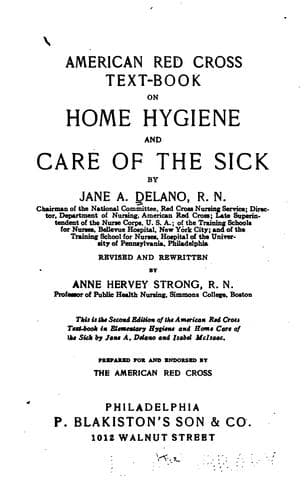
American Red Cross Text-Book on Home Hygiene and Care of the SickAmerican National Red Cross
Science
American Red Cross Text-Book on Home Hygiene and Care of the Sick
American National Red Cross
Home nursing; Hygiene; Nurses; Nursing
The compress should be securely bandaged in place, or its edges may be
fastened with adhesive plaster or collodion. Neither of the two latter
should cover the wound itself. The outside bandage may be changed when
soiled, but the compress itself should not be disturbed until the wound
has healed. It is a mistake to dress wounds oftener than necessary,
since handling them always increases the chance of introducing germs.
Most children, like Tom Sawyer, delight in wounds, but they should be
prevented if possible both from inspecting and from exhibiting them.
If heat, swelling, redness, or pain develop in a wound after a day or
two, a doctor should be consulted; and not a minute should be lost if
the patient has a chill or if red streaks appear extending from the
wound in the general direction of the heart. Until the doctor comes the
wounded part should be elevated and covered with cold applications wet
in alcohol 25%, or in a solution of common salt, a teaspoonful to a pint
of water.
Several points should be remembered in dressing wounds. In the first
place the mouth, which is full of germs, is not a good place for cut
fingers. Moreover, wounds should not be touched by anything, especially
the fingers, either washed or unwashed, nor should the scissors, fingers
or other object be allowed to touch the surface of the dressing that is
to be placed directly upon a wound. Unless they contain gross dirt
wounds should not be washed with water, since washing introduces another
chance of infection and accomplishes nothing except a tidy appearance,
which is not essential. Furthermore, it should be remembered that
exposure to the air will not infect a wound, and therefore time should
be taken to find a suitable dressing. When a sterile dressing is quite
impossible to obtain, the cleanest material available should be used;
one of the best substitutes for a sterile dressing is the inner surface
of a handkerchief or napkin that has not previously been unfolded since
it was ironed. It is a common mistake to tie up a wound in the first
article presented, which is usually a generous by-stander's soiled
handkerchief. The same precautions in regard to cleanliness should be
taken in dressing wounds that are known to be contaminated, since even
into an infected wound it is possible to introduce more germs and more
virulent ones.
NOSEBLEED usually stops of itself, but if it is obstinate the patient
should sit erect with the head back, and cold compresses should be
placed on the nose and at the back of the neck. Pressure should be made
on the upper lip by means of the fingers, or by a firm roll of paper or
cotton placed under the upper lip. Salt or vinegar in water, a
teaspoonful of either one to a cup of water, may be snuffed up the nose.
The treatment should be continued for ten or fifteen minutes, or until
bleeding stops; if the bleeding persists a doctor is needed.
Public-domain text, read in full here on John Shaqi.
Reviews
Reviews
No reviews yet
Be the first to share your thoughts on this work.
Elsewhere in the archive
Join the Discussion
Join the discussion
Sign in to leave a comment or review.
Sign InorCreate an account