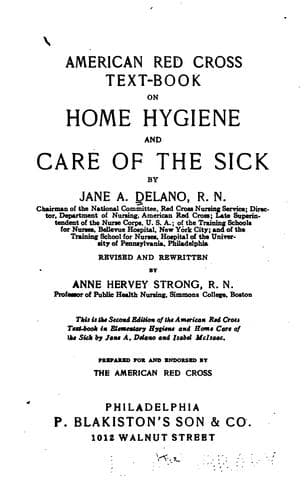
American Red Cross Text-Book on Home Hygiene and Care of the SickAmerican National Red Cross
Science
American Red Cross Text-Book on Home Hygiene and Care of the Sick
American National Red Cross
Home nursing; Hygiene; Nurses; Nursing
In many cases of sickness institutional care has marked advantages. It
may be the only solution when adequate provision for the sick is
impossible at home; and it is often a necessity when a patient requires
special equipment or apparatus, expert nursing, and medical attention
within reach both day and night.
On the other hand, it would not be desirable even if it were possible
for all sick persons to be cared for in institutions. Care at home when
it is adequate may be more successful than equally skillful care given
elsewhere, since the sick quite as much as the well are injured by long
separation from normal family life. Most children, because they need the
attention of their own mothers, most convalescent and chronic patients,
and most aged persons are cared for at home; and in the great majority
of cases no better place for them could be found. Since patients of
these four groups have needs peculiar to themselves, some special
points in caring for them are considered in this chapter.
CHILDREN
Ability to observe quickly and accurately is seldom more needed than it
is by a woman who cares for children. No one expects babies to explain
their troubles, but people forget that small children are unable to
describe their physical sensations with any degree of accuracy, although
discomfort or sickness may show itself in all degrees of ill temper and
bad conduct. For these exhibitions many a suffering child has been
punished, where an older and more articulate person would have received
considerate attention.
Children, like babies, have a low resistance to disease. Moreover, they
react quickly both to favorable and to unfavorable surroundings. Hence
slight causes sometimes produce pronounced or even violent symptoms in
children without giving cause for great anxiety, although the same
symptoms if exhibited by adults, might indicate critical illness. On the
other hand the recuperative power of children is high, and their
recoveries are sometimes surprisingly rapid. It is a mistake, when a
child has completely recovered from an acute but brief illness, to
coddle him for weeks afterward merely because a grown person in similar
circumstances would have failed to regain his strength.
When a child is sick in bed, especial efforts should be made to insure
adequate ventilation without chilling him. Children always lose heat
rapidly because the body surface is proportionately large; when they are
ill, therefore, it is especially necessary to keep them well covered, to
see that their hands and feet are warm, and to avoid chilling them
during their baths. But overheating must also be avoided, since all
children, sick or well, who are too warmly dressed or who stay in rooms
that are too warm, become weak and irritable and more susceptible than
others to colds and other respiratory disorders. The child's skin should
be kept clean and dry, but he should not be disturbed nor handled
unnecessarily.
Public-domain text, read in full here on John Shaqi.
Reviews
Reviews
No reviews yet
Be the first to share your thoughts on this work.
Elsewhere in the archive
Join the Discussion
Join the discussion
Sign in to leave a comment or review.
Sign InorCreate an account