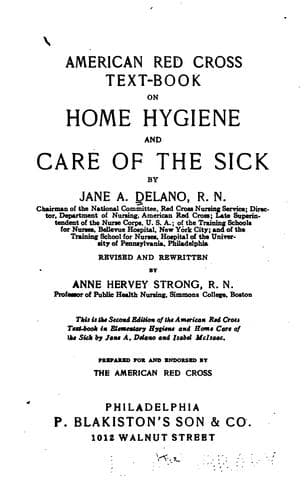
American Red Cross Text-Book on Home Hygiene and Care of the SickAmerican National Red Cross
Science
American Red Cross Text-Book on Home Hygiene and Care of the Sick
American National Red Cross
Home nursing; Hygiene; Nurses; Nursing
Sick children require very simple food at short intervals. Variety is
not so necessary for a child as for an adult, unless the child has been
allowed to form bad habits of eating. Sick children should not be
indulged unnecessarily, either in regard to their food or in other ways.
However, attempts made during an illness to change the habits of a badly
trained child are unwise because usually unsuccessful; parents who sow
the wind by neglecting to train their children when they are in good
health may as well make up their minds to reap a veritable whirlwind
when the children are ill. Even when children are well trained it is
difficult and sometimes impossible to prevent them from forming bad
habits during sickness. Yet the labor of training a child reaps perhaps
at no other time a richer reward than it does when the child is ill, and
his recovery might be seriously impeded by unwillingness to accept
necessary food, medicine, or treatment.
PHYSICAL DEFECTS are faults in the structure of the body; adenoid
growths, imperfect eyes, abnormally curved spines, and defective teeth
are examples. Most physical defects can be cured in childhood by
treatment or by slight operations. If untreated they frequently lead to
sickness or to serious impairment of the body, and if neglected until
adult life their injurious consequences are generally beyond remedy,
even when the defects themselves can be repaired.
Some indications of common physical defects are given below; they ought
to be more generally known than they are. If a child exhibits one or
more of the symptoms mentioned, he ought to be given a complete physical
examination by a competent physician, and treatment, if needed, should
begin without delay. The idea that children will outgrow these defects
without treatment is erroneous. Better, however, than waiting until
symptoms appear is the modern way of giving every child a physical
examination at stated intervals, a practice already common in public
schools where effective health work is carried on.
EYESTRAIN frequently comes from imperfections in the shape of the eye;
these imperfections can almost always be corrected by glasses. When a
child is suffering from eyestrain, the eyes themselves may show
indications of trouble; they may be blood-shot, the lids may itch or be
crusted or inflamed, or styes may appear. In other cases the symptoms of
eyestrain have no apparent connection with the eyes; such symptoms are
headache, nausea, vomiting, indigestion, fatigue, irritability, poor
scholarship, and nervous exhaustion. If a child shows any of these
symptoms, or if he rubs his eyes, frowns, squints, wrinkles his
forehead, sits bent over his book, or develops round shoulders, there is
sufficient reason for having his eyes examined by an oculist.
Examination by an optician should not be considered sufficient.
Public-domain text, read in full here on John Shaqi.
Reviews
Reviews
No reviews yet
Be the first to share your thoughts on this work.
Elsewhere in the archive
Join the Discussion
Join the discussion
Sign in to leave a comment or review.
Sign InorCreate an account