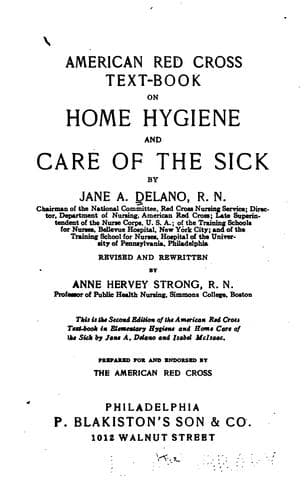
American Red Cross Text-Book on Home Hygiene and Care of the SickAmerican National Red Cross
Science
American Red Cross Text-Book on Home Hygiene and Care of the Sick
American National Red Cross
Home nursing; Hygiene; Nurses; Nursing
Hopefulness promotes health, while discouragement, apprehension, and
unhappiness lower the tone of the whole system. Hence set backs,
failures, delays, and relapses should not be dwelt upon, but signs of
progress should be mentioned; judiciously however, since overdone
attempts to cheer a patient seldom fail to have the opposite effect. If
objects or situations that suggest undesirable thoughts are eliminated,
the less often those thoughts tend to recur. Therefore, in order to
break the habit of sickness, old thoughts must be gradually banished
and new ones must be substituted. Sick-room appliances should be put out
of sight as soon as they are no longer needed, and the patient may
profit by moving into a different bed room. A few days spent away from
home as soon as his strength permits often prove effective in breaking
up sickness associations; the patient is generally encouraged when he
finds that he can sleep in a different bed, endure some fatigue, and
exist without daily visits from the doctor. Even a day spent at a
different house in the same town sometimes directs the patient's
thoughts into fresh channels. Gradually, but as quickly as safety
allows, he should take his place in the normal family life and cease to
be treated as an exception.
Merely eliminating associations with sickness, however, is not enough;
and exhorting a patient to forget himself and to become interested in
something seldom accomplishes anything, especially if he is so depleted
by illness that the thought of everyday activities suggests only
weariness and pain. A person so weak that he is thoroughly fatigued by
dressing himself should not be expected to view with enthusiasm the
prospect of a full day's work. Much, however, may be accomplished by
providing something that the patient really likes to do, and deliberate
efforts must be made to stimulate his interest in some occupation,
however simple it may be.
Occupations for invalids are more than a means to pass away the time;
they are also of distinct curative value. The patient's interest is not
always easy to arouse, and some ingenuity may be needed in the
beginning; sometimes interest is best aroused by working at some
handicraft in his presence, and finally offering, as a favor, to teach
him to do it also. His interest in any occupation is invariably
increased if a well person not only directs but shares in the work.
Public-domain text, read in full here on John Shaqi.
Reviews
Reviews
No reviews yet
Be the first to share your thoughts on this work.
Elsewhere in the archive
Join the Discussion
Join the discussion
Sign in to leave a comment or review.
Sign InorCreate an account