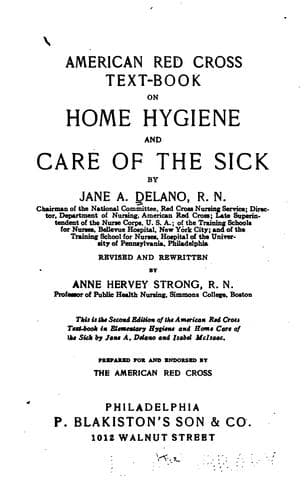
American Red Cross Text-Book on Home Hygiene and Care of the SickAmerican National Red Cross
Science
American Red Cross Text-Book on Home Hygiene and Care of the Sick
American National Red Cross
Home nursing; Hygiene; Nurses; Nursing
The regular daily care of the patient and of his room, already described
in this book, should be scrupulously carried out, and no less
scrupulously during the tenth year than it was during the tenth day.
Cleanliness in every detail is absolutely essential to the patient's
welfare; no one is more unpleasant either to himself or to others than a
chronic patient who is neglected. Patients who are constantly in bed, it
should be remembered, and paralyzed patients in particular, are
peculiarly susceptible to pressure sores. If a patient is able, it is
extremely important for him to sit up in a chair part of the day.
Sitting up should never be omitted because it involves the expenditure
of time and trouble for the attendant.
It is often said that for most people some personal experience of
sickness is beneficial; it can safely be said, however, that no one
benefits from spending any considerable portion of his life in a state
of helplessness and suffering. Behavior and character itself are
determined by influences constantly coming into the mind from daily
surroundings and associations with other people: one who recalls this
fact needs only a moment's reflection to realize how ill adapted to
healthy development of mind and character are the limited lives of the
sick. Especially unfortunate is the situation of chronic invalids, shut
off as they are from the objective interests and activities of normal
life, deprived of all practice in making the salutary small adjustments
and sacrifices required in every day living with other people, and
self-centered as they necessarily tend to become from the inevitable
focusing of attention upon their own discomforts and pain.
On the whole, a surprisingly large number of invalids successfully
resist the disintegrating effects of sickness upon character. But it is
nevertheless true, as Dr. Weir Mitchell says, that "Sickness ennobles a
few but debases many." A selfish invalid has more than once destroyed
the happiness of an entire family, or spoiled the life of one member of
it by monopolizing her whole time and attention. Families should
remember that their injudicious sacrifices seldom bring enduring
happiness or contentment to the patient himself; indeed, in the long run
such sacrifices generally injure him even more than they injure his
victims. Clearly much must and should be sacrificed by members of a
family to the needs of an invalid; but in general it may be said that a
sacrifice is injudicious if it relieves the patient of activity or
responsibility that he can support without injury, if it makes him more
dependent in mind or body, if it results in restricting his attention to
himself and his affairs, or if it increases his tendency to make demands
on others.
Public-domain text, read in full here on John Shaqi.
Reviews
Reviews
No reviews yet
Be the first to share your thoughts on this work.
Elsewhere in the archive
Join the Discussion
Join the discussion
Sign in to leave a comment or review.
Sign InorCreate an account