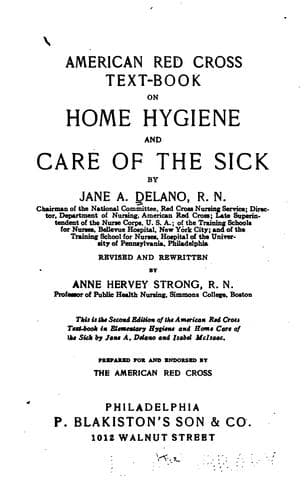
American Red Cross Text-Book on Home Hygiene and Care of the SickAmerican National Red Cross
Science
American Red Cross Text-Book on Home Hygiene and Care of the Sick
American National Red Cross
Home nursing; Hygiene; Nurses; Nursing
DIGESTIVE TRACT.--The entire alimentary canal, including the mouth,
œsophagus, stomach, and the small and large intestines.
DIPLOCOCCUS.--A form of coccus in which two individuals remain attached
after cell division has taken place.
DISINFECT.--To destroy the germs of disease.
DISINFECTANT.--An agent that destroys the germs of disease.
DISINFECTION.--The process of destroying the germs of disease.
E
EMETIC.--A substance used to induce vomiting.
ENEMA.--An injection of fluid into the rectum.
F
FECAL.--Pertaining to feces.
FECES.--Matter discharged from the bowels; bowel movement.
FERMENTATION.--Decomposition produced in an organic substance by the
action of certain living agents.
FISSION.--The process by which a cell divides into two parts.
FLAGELLUM (pl. flagella).--A long hair-like appendage, by the action of
which certain micro-organisms are enabled to move.
FLEX.--To bend at a joint.
FOMENTATION.--See _Stupe_.
G
GASTRIC JUICE.--The fluid secreted by the glands of the stomach.
GERM.--A minute unicellular organism, either animal or vegetable; a
micro-organism; a microbe.
GERMICIDE.--An agent having the power to kill germs.
H
HOST.--An animal or plant in or upon which another organism lives.
I
IMMUNE.--Not susceptible to a particular disease; also, a person who is
not susceptible to a particular disease.
IMMUNITY.--The state in which an individual is not susceptible to a
particular disease.
IMMUNIZE.--To render immune.
INCUBATION.--The interval between exposure to an infectious disease and
the first appearance of symptoms.
INFECT.--To communicate disease germs.
INFECTION.--An agent by which disease may be communicated from one
individual to another; also, an infectious disease.
INOCULATE.--To introduce any biological product directly into the
tissues of the body.
INOCULATION.--The process of inoculating.
INTESTINAL TRACT.--The small and large intestines.
M
MICROBE.--See _Germ_.
MICRO-ORGANISM.--See _Germ_.
MUCUS.--The substance secreted by mucous membranes.
MUCOUS MEMBRANES.--The membranes lining certain cavities of the body,
especially the digestive and respiratory tracts.
N
NUTRIENT.--One of several chemical groups to which the essential
constituents of food belong.
O
ORGANIC.--Derived from or relating to an organism.
ORGANISM.--An individual that is or has been alive.
P
PARASITE.--An individual that lives in or upon another individual.
PASTEURIZATION.--The process of pasteurizing.
PASTEURIZE.--To subject milk to a temperature of 142°-145° Fahrenheit
for thirty minutes.
PATHOGENIC.--Disease-producing.
PERTUSSIS.--Whooping-cough.
PROTEID.--One of the complex nitrogenous substances constituting the
essential parts of animal and vegetable tissues.
PROTOZOÖN (pl. protozoa).--An animal organism composed of a single cell.
PUS.--The fluid product of inflammation; matter.
Public-domain text, read in full here on John Shaqi.
Reviews
Reviews
No reviews yet
Be the first to share your thoughts on this work.
Elsewhere in the archive
Join the Discussion
Join the discussion
Sign in to leave a comment or review.
Sign InorCreate an account