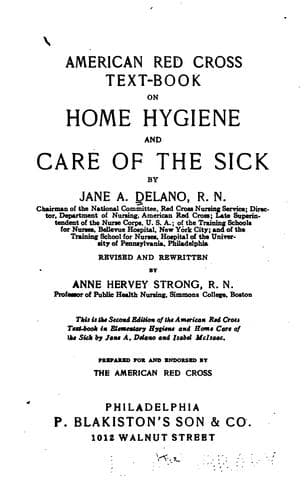
American Red Cross Text-Book on Home Hygiene and Care of the SickAmerican National Red Cross
Science
American Red Cross Text-Book on Home Hygiene and Care of the Sick
American National Red Cross
Home nursing; Hygiene; Nurses; Nursing
PUTREFACTION.--Decomposition of nitrogenous organic matter brought about
by micro-organisms and accompanied by a foul odor.
R
RESISTANCE.--See _Immunity_.
RESPIRATORY TRACT.--The air passages, including the nose, mouth, larynx,
trachea, bronchial tubes, and lungs.
S
SAPROPHYTE.--A vegetable organism that lives on decaying organic matter.
SARCINA.--Literally, a bundle. Applied to bacteria grouped in bundles or
packets.
SEPTIC.--Putrefying or decomposing; infected by pus-producing bacteria.
SEQUELA.--A disease or unhealthy condition following another disease or
unhealthy condition.
SERUM.--The fluid which separates from the clot after blood has
coagulated; especially, that containing an antitoxin.
SEWAGE.--Any substance containing urine or fecal matter; also, the
substance which passes through sewers.
SPIRILLUM (pl. spirilla).--A variety of bacteria having spirally twisted
cells.
SPORE.--A resting stage, characterized by great resistance, into which
certain germs enter when conditions become unfavorable for their growth.
SPUTUM.--Spit; expectoration.
STAPHYLOCOCCUS.--A variety of bacteria that group themselves in masses
resembling bunches of grapes.
STERILE.--Free from living germs; aseptic.
STERILIZATION.--The process of rendering sterile.
STERILIZE.--To render sterile.
STREPTOCOCCUS.--A variety of bacteria that arrange themselves in chains.
STUPE.--A cloth wrung out of hot water and applied to the surface of the
body.
SUSCEPTIBLE.--Lacking resistance to a disease.
SUSCEPTIBILITY.--The condition in which resistance to a disease is low.
T
TETRAD.--A variety of bacteria that arrange themselves in groups of
four.
TISSUE.--A collection of cells having the same function.
TOXIN.--A poison produced by the action of micro-organisms.
U
UNICELLULAR.--Composed of a single cell.
UTERUS.--The womb.
V
VACCINATE.--To inoculate with a poison in order to bring about immunity
to a disease.
VACCINE.--Any substance which if introduced into the body causes the
formation of protective substances.
VOMITUS.--Vomited substances.
INDEX
A
Abdomen, 68
Abdominal binder, 68
Action of drugs, 200
Adenoids, 284
Aged, care of, 303
Ailments and emergencies, 257
Air, 72
Alcohol, 160
Appliances,
bed cradles, 173
bedpans, 176
rubber utensils, 138
Applications, local, 220
cold, dry, 231
cold, moist, 235
hot, dry, 225
bricks, 226
flannel, 226
salt or sand, 226
water bags, 225
hot, moist, 227
fomentations, 229
poultices, 227
stupes, 229
Attendant, 127
B
Bacteria, 1, 4, 5
bacilli, 5
coccus, 4
effects produced by, 3
entrance into the body, 9
food of, 2
immunity, 13
in food, 19
in water, 19
methods of study, 1
motion, 5
origin of communicable diseases, 3
parasites, 3, 8
saprophytes, 2
shape, 4
spirillum, 4
spores, 7
structure and development, 4
where found, 8
Public-domain text, read in full here on John Shaqi.
Reviews
Reviews
No reviews yet
Be the first to share your thoughts on this work.
Elsewhere in the archive
Join the Discussion
Join the discussion
Sign in to leave a comment or review.
Sign InorCreate an account