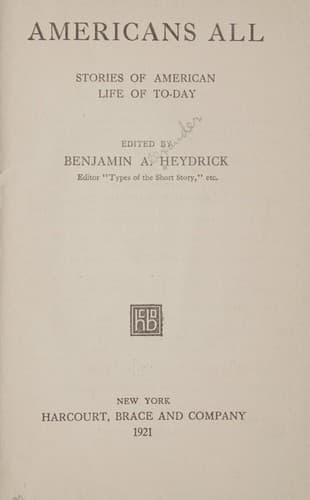
Short stories, American; United States -- Social life and customs -- Fiction
2. Notice the familiar, almost conversational style. Is it suited
to the story? Why?
3. Show how the opening paragraph introduces the main idea of the
story.
4. To make a story there must be a conflict of some sort. What is
the conflict here?
5. How does the account of Julia Neal's career as a teacher (page
64) prepare for the ending of the story?
6. Do you have a clear picture in your mind of Mrs. Winthrop? Of
Mrs. Worthington? Why did not the author tell about their personal
appearance?
7. Point out humorous touches in the next to the last paragraph.
8. Is this story true to life? Who is the Priscilla Winthrop of
your town?
9. What impression do you get of the man behind this story? Do you
think he knew the people of his town well? Did he like them even
while he laughed at them? What else can you say about him?
10. Other books of short stories dealing with life in a small town
are: _Pratt Portraits_, by Anna Fuller; _Old Chester Tales_, by
Margaret Deland; _Stories of a Western Town_, by Octave Thanet; _In
a Little Town_, by Rupert Hughes; _Folks Back Home_, by Eugene
Wood; _Friendship Village_, by Zona Gale; _Bodbank_, by Richard W.
Child. Read one of these books, or a story from one, and compare it
with this story.
11. In what ways does life in a small town differ from life in a
large city?
THE GIFT OF THE MAGI
This story, taken from the volume called _The Four Million_, is a good
example of O. Henry's method as a short-story writer. It is notable for
its brevity. The average length of the modern short story is about five
thousand words; O. Henry uses a little over one thousand words. This
conciseness is gained in several ways. In his descriptions, he has the
art of selecting significant detail. When Della looks out of the window,
instead of describing fully the view that met her eyes, he says: "She
looked out dully at a grey cat walking a grey fence in a grey backyard."
A paragraph could do no more. Again, the beginning of the story is
quick, abrupt. There is no introduction. The style is often elliptical;
in the first paragraph half the sentences are not sentences at all. But
the main reason for the shortness of the story lies in the fact that the
author has included only such incidents and details as are necessary to
the unfolding of the plot. There is no superfluous matter.
Public-domain text, read in full here on John Shaqi.
Reviews
Reviews
No reviews yet
Be the first to share your thoughts on this work.
Elsewhere in the archive
Join the Discussion
Join the discussion
Sign in to leave a comment or review.
Sign InorCreate an account