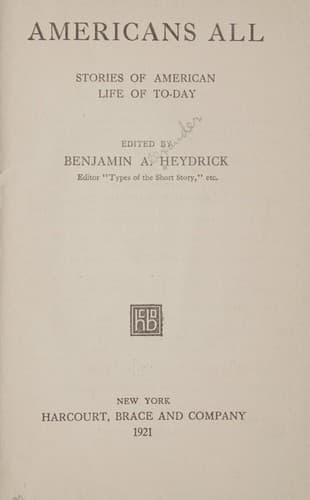
Short stories, American; United States -- Social life and customs -- Fiction
Another characteristic of O. Henry is found in the unexpected turns of
his plots. There is almost always a surprise in his stories, usually at
the end. And yet this has been so artfully prepared for that we accept
it as probable. Our pleasure in reading his stories is further
heightened by the constant flashes of humor that light up his pages. And
beyond this, he has the power to touch deeper emotions. When Della heard
Jim's step on the stairs, "she turned white just for a moment. She had a
habit of saying little silent prayers about the simplest things, and now
she whispered, 'Please God, make him think I am still pretty.'" One
reads that with a little catch in the throat.
In his plots, O. Henry is romantic; in his settings he is a realist.
Della and Jim are romantic lovers, they are not prudent nor calculating,
but act upon impulse. In his descriptions, however, he is a realist. The
eight-dollar-a-week flat, the frying pan on the back of the stove, the
description of Della "flopping down on the couch for a cry," and
afterwards "attending to her cheeks with the powder-rag,"--all these are
in the manner of realism.
And finally, the tone of his stories is brave and cheerful. He finds the
world a most interesting place, and its people, even its commonplace
people, its rogues, its adventurers, are drawn with a broad sympathy
that makes us more tolerant of the people we meet outside the books.
1. Compare the beginning of this story with the beginning of
"Bitter-Sweet." What difference do you note?
2. Select a description of a person that shows the author's power
of concise portraiture.
3. What is the turn of surprise in this story? What other stories
in this book have a similar twist at the end?
4. What is the central thought of this story?
5. Other stories of O. Henry's that ought not to be missed are "An
Unfinished Story" and "The Furnished Room" in _The Four Million_;
"A Blackjack Bargainer" in _Whirligigs_; "Best Seller" and "The
Rose of Dixie" in _Options_; "A Municipal Report" in _Strictly
Business_; "A Retrieved Reformation" in _Roads of Destiny_; and
"Hearts and Crosses" in _Hearts of the West_.
THE GOLD BRICK
This story, first published in the _American Magazine_, was reprinted in
a volume called _The Gold Brick_, published in 1910. The quotation "chip
at crusts like Hindus" is from Robert Browning's poem "Youth and Art."
The reference to "Old Walt" at the end of the story is to Walt Whitman,
one of the great poets of democracy.
Public-domain text, read in full here on John Shaqi.
Reviews
Reviews
No reviews yet
Be the first to share your thoughts on this work.
Elsewhere in the archive
Join the Discussion
Join the discussion
Sign in to leave a comment or review.
Sign InorCreate an account