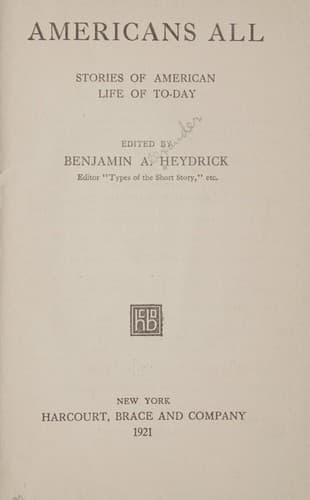
Short stories, American; United States -- Social life and customs -- Fiction
9. This story is taken from the book called _Roast Beef, Medium_.
Other good books of short stories by this author are _Personality
Plus_, and _Cheerful--by Request_.
BITTER-SWEET
1. Note the introduction, a characteristic of all of Fannie Hurst's
stories. What purpose does it serve here? What trait of Gertie's is
brought out? Is this important to the story?
2. From the paragraph on page 139 beginning "It was into the
trickle of the last----" select examples that show the author's
skill in the use of words. What other instances of this do you note
in the story?
3. Read the sketch of the author. What episode in her life gave her
material for parts of this story?
4. Notice how skillfully the conversation is handled. The opening
situation developes itself entirely through dialogue, yet in a
perfectly natural way. It is almost like a play rather than a
story. If it were dramatized, how many scenes would it make?
5. What does the title mean? Does the author give us the key to its
meaning?
6. What do you think of Gertie as you read the first part of the
conversation in the restaurant? Does your opinion of her change at
the end of the story? Has her character changed?
7. Is the ending of the story artistic? Why mention the time-clock?
What had Gertie said about it?
8. State in three or four words the central idea of the story. Is
it true to life?
9. What is the meaning of these words: atavism; penumbra;
semaphore; astigmatic; insouciance; mise-en-scene; kinetic?
10. Other books of stories dealing with life in New York City are
_The Four Million_, and _The Voice of the City_, by O. Henry; _Van
Bibber and Others_, by Richard Harding Davis; _Every Soul Hath Its
Song_, by Fannie Hurst; _Doctor Rast_, by James Oppenheim.
THE RIVERMAN
1. In how many scenes is this story told? What is the connection
between them?
2. Is there anything in the first description of Dicky Darrell that
gives you a slight prejudice against him?
3. Why was the sympathy of the crowd with Jimmy Powers in the
birling match?
4. Comment on Jimmy's remark at the end of the story. Did he mean
it, or is he just trying to turn away the praise?
5. What are the characteristics of a lumberman, as seen in Jimmy
Powers?
6. Read the sketch of Stewart Edward White, and decide which one of
his books you would like to read.
FLINT AND FIRE
1. What does the title mean?
2. How does the author strike the keynote of the story in the
opening paragraph?
3. Where is the first hint of the real theme of the story?
4. Point out some of the dialect expressions. Why is dialect used?
5. What turn of surprise comes at the end of the story? Is it
probable?
Public-domain text, read in full here on John Shaqi.
Reviews
Reviews
No reviews yet
Be the first to share your thoughts on this work.
Elsewhere in the archive
Join the Discussion
Join the discussion
Sign in to leave a comment or review.
Sign InorCreate an account