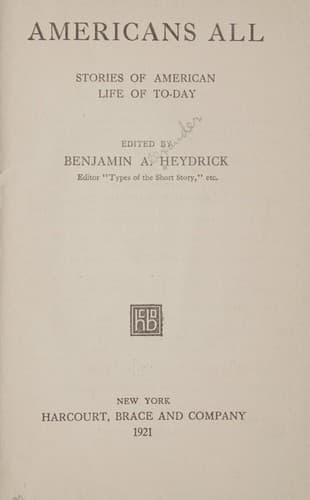
Short stories, American; United States -- Social life and customs -- Fiction
1. To make a story interesting, there must be a conflict. In this
the conflict is double: the outer conflict, between the two
political factions, and the inner conflict, in the soul of the
artist. Note how skilfully this inner struggle is introduced: at
the moment when Kittrell is first rejoicing over his new position,
he feels a pang at leaving the _Post_, and what it stood for. This
feeling is deepened by his wife's tacit disapproval; it grows
stronger as the campaign progresses, until the climax is reached in
the scene where he resigns his position.
2. If you knew nothing about the author, what could you infer from
this story about his political ideals? Did he believe in democracy?
Did he have faith in the good sense of the common people? Did he
think it was worth while to make sacrifices for them? What is your
evidence for this?
3. How far is this story true to life, as you know it? Do any
newspapers in your city correspond to the _Post_? To the
_Telegraph_? Can you recall a campaign in which the contest was
between two such groups as are described here?
4. Does Whitlock have the art of making his characters real? Is
this true of the minor characters? The girl in the flower shop, for
instance, who appears but for a moment,--is she individualized?
How?
5. Is there a lesson in this story? State it in your own words.
6. What experiences in Whitlock's life gave him the background for
this story?
7. What new words did you gain from this? Define meritricious;
prognathic; banal; vulpine; camaraderie; vilification; ennui;
quixotic; naive; pharisaism. What can you say of Whitlock's
vocabulary?
8. Other good stories dealing with politics are found in
_Stratagems and Spoils_, by William Allen White.
HIS MOTHER'S SON
1. Note the quick beginning of the story; no introduction, action
from the start. Why is this suitable to this story?
2. Why is slang used so frequently?
3. Point out examples of humor in the story.
4. In your writing, do you ever have trouble in finding just the
right word? Note on page 123 how Edna Ferber tries one expression
after another, and how on page 122 she finally coins a
word--"unadjectivable." What does the word mean?
5. Do you have a clear picture of Emma McChesney? Of Ed Meyers?
Note that the description of Meyers in the office is not given all
at once, but a touch here and then. Point out all these bits of
description of this person, and note how complete the portrait is.
6. What have you learned in this story about the life of a
traveling salesman?
7. What qualities must a good salesman possess?
8. Was Emma McChesney a lady? Was Ed Meyers a gentleman? Why do you
think so?
Public-domain text, read in full here on John Shaqi.
Reviews
Reviews
No reviews yet
Be the first to share your thoughts on this work.
Elsewhere in the archive
Join the Discussion
Join the discussion
Sign in to leave a comment or review.
Sign InorCreate an account