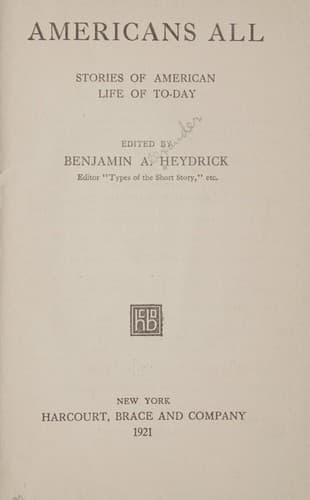
Short stories, American; United States -- Social life and customs -- Fiction
Yet while the critics continued their hopeless hunt, there was growing
up in this country a form of fiction which gave promise of some day
achieving the task that this never-to-be written novel should
accomplish. This form was the short story. It was the work of many
hands, in many places. Each writer studied closely a certain locality,
and transcribed faithfully what he saw. Thus the New England village,
the western ranch, the southern plantation, all had their chroniclers.
Nor was it only various localities that we saw in these one-reel
pictures; they dealt with typical occupations, there were stories of
travelling salesmen, stories of lumbermen, stories of politicians,
stories of the stage, stories of school and college days. If it were
possible to bring together in a single volume a group of these, each one
reflecting faithfully one facet of our many-sided life, would not such a
book be a truer picture of America than any single novel could present?
The present volume is an attempt to do this. That it is only an attempt,
that it does not cover the whole field of our national life, no one
realizes better than the compiler. The title _Americans All_ signifies
that the characters in the book are all Americans, not that they are all
of the Americans.
This book then differs in its purpose from other collections of short
stories. It does not aim to present the world's best short stories, nor
to illustrate the development of the form from Roman times to our own
day, nor to show how the technique of Poe differs from that of Irving:
its purpose is none of these things, but rather to use the short story
as a means of interpreting American life. Our country is so vast that
few of us know more than a small corner of it, and even in that corner
we do not know all our fellow-citizens; differences of color, of race,
of creed, of fortune, keep us in separate strata. But through books we
may learn to know our fellow-citizens, and the knowledge will make us
better Americans.
The story by Dorothy Canfield has a unique interest for the student, in
that it is followed by the author's own account of how it was written,
from the first glimpse of the theme to the final typing of the story.
Teachers who use this book for studying the art of short story
construction may prefer to begin with "Flint and Fire" and follow with
"The Citizen," tracing in all the others indications of the authors'
methods.
BENJAMIN A. HEYDRICK.
NEW YORK CITY,
March, 1920.
CONTENTS
PAGE
I. IN SCHOOL DAYS
THE RIGHT PROMETHEAN FIRE _George Madden Martin_ 3
Sketch of George Madden Martin 16
II. JUST KIDS
THE LAND OF HEART'S DESIRE _Myra Kelly_ 21
Sketch of Myra Kelly 37
Public-domain text, read in full here on John Shaqi.
Reviews
Reviews
No reviews yet
Be the first to share your thoughts on this work.
Join the Discussion
Join the discussion
Sign in to leave a comment or review.
Sign InorCreate an account