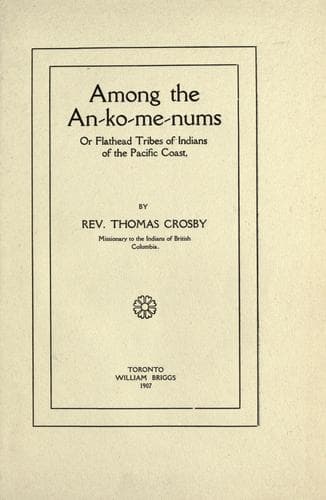
Among the An-ko-me-nums, or Flathead Tribes of Indians of the Pacific CoastCrosby, Thomas
History
Among the An-ko-me-nums, or Flathead Tribes of Indians of the Pacific Coast
Crosby, Thomas
Indians of North America -- Missions; Salish Indians
We looked around when he had finished and saw a number of the most
hardened sinners in tears and broken down by the earnest, loving,
living message of the young Indian preacher. Who can measure the
results of that strong and sympathetic appeal? Never can it fade from
my memory or its effect be effaced from the heart. We feel that the
Great Shepherd alone can tell how many of His sheep were found by the
call given in that “Steamboat Whistle Sermon” by His young servant on
the old camp-ground on the banks of the Fraser. One man was saved that
day who became well known as a faithful worker among the Indians in
after days. This was old Captain Tsit-see-mit-ston, who lived at the
head of Sumas Lake.
David knew nothing of fear in the prosecution of his work for the
Master. Many a time, in the midst of circumstances most trying, would
he declare his allegiance to Christ. Never was he ashamed of his
Saviour, and his young heart was so full of love for Him that the
influence was felt by all who came near to his warm and faithful life.
Although his opportunities were few and his advantages limited, owing
to a lack of an English education, he was a living demonstration of the
fact that “God often chooses the weak things of the world to confound
the things that are mighty.”
On one occasion he was accompanying me on a missionary trip which
included a visit to a sick Indian who lived up the Chilliwack River.
When we arrived at Skowkale, on the east bank of the river, a priest
came to the opposite side. He seemed desirous of crossing the river (it
was before the river had changed its course at Vedder Crossing), and as
there was no bridge, and no canoe or boat on his side, he called to the
Indians on our side to come over and fetch him. I told them to go for
the man, but they said, “Oh, no, we don’t want that teacher any more.”
“But,” said I, “it is only politeness to row the man over if he wishes
it; you do not need to listen to him or follow his teaching, but you
ought to be kind and help any man when you can.”
At last they were persuaded, and rowed across after the man, bringing
him to our side. When the priest arrived on the bank of the river I
said:
“Good-morning, sir, you seem to be travelling.”
“Yes,” said he, “I am going up to see a sick man at the village above.”
“Oh, indeed,” said I; “my little friend and I were just going to the
same place.”
“Then,” said the man, in a mixture of French and English, “you better
not go, he is my convert.”
“Yes,” said I, “but I have been to see the sick man before, and I
thought of going again.”
“Then,” said he, “you people are all in the wrong way; it is no good
you go.”
“Well,” said I, “which way are you in? Here is my chart,” holding up
the Bible. At this he got angry, and said, “That book is no good.”
Public-domain text, read in full here on John Shaqi.
Reviews
Reviews
No reviews yet
Be the first to share your thoughts on this work.
Elsewhere in the archive
Join the Discussion
Join the discussion
Sign in to leave a comment or review.
Sign InorCreate an account