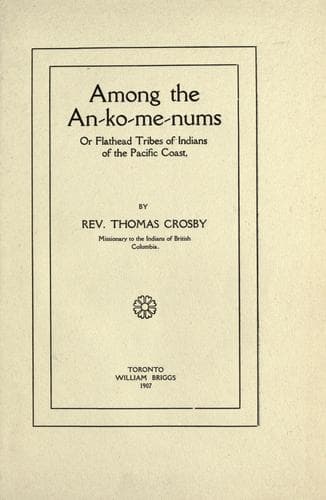
Among the An-ko-me-nums, or Flathead Tribes of Indians of the Pacific CoastCrosby, Thomas
History
Among the An-ko-me-nums, or Flathead Tribes of Indians of the Pacific Coast
Crosby, Thomas
Indians of North America -- Missions; Salish Indians
Now the friends of both parties rushed in from all sides of the
village, and in a few moments the great Indian house, some seventy
feet long by thirty broad, was filled with a quarrelling multitude.
Fortunately some torches were lighted, which enabled us to take in the
scene, and for hours and hours Amos Cushan and I were rushing between
quarrelling parties to stop their fighting. One would be struck with a
club here, another with some sharp instrument there, and blood flowed
freely. Amidst it all continued the awful din of rushing feet and the
howls and screams of hellish rage.
Suddenly Quin-num, the son of old Qual-la-kup, dashed in. He had just
heard of the trouble, away at the other end of the village, and jumping
out of bed and tucking his blanket around him, he seized the first
weapon to hand, a claw-hammer, and hurried to the rescue of his father.
I saw him rush in, trembling with anger, and I said, “Quin-num, be
good! Don’t fight!”
“Oh,” he said, and his voice was wild with rage, “I could listen to
what you say, but look at the blood of my father!”
And with that he let out an awful yell, and wheeling around, struck
with the hammer the old chief who had clubbed his father, cutting his
eye nearly out.
Then the fighting commenced with renewed vigor and continued until four
in the morning. We were nearly exhausted trying to get these savage
men reconciled. It was evident that the old chief and his nephew had
urged on the young men, and perhaps had given them whiskey to get them
to undertake this dark deed. It was an old quarrel, and jealousy and
pride were at the bottom of it. Qual-la-kup was a quiet old man and his
people were generally respected. His son, Quin-num, had married into
Squin-es-ton’s tribe and seemed likely to secure a ruling position,
which moved the other chief and his people to jealousy.
While we were in the midst of this excitement, and hardly knowing who
would be the next to fall, there came a lull in the storm, and we
lifted up our hearts to God for help and direction.
Just then Tsil-ka-mut arrived on the scene from the other end of the
village, all painted and with his blanket tucked around his waist. The
great big fellow did not touch anything or anybody, but just danced
about, up and down, crying out, “My children, my children, don’t be
like little boys!” And you could feel the contempt in his tone. “Our
fathers used to fight, but they would go and fight like men till they
were wading in blood, and take many scalps. They would never go and
take a man out of his bed unexpectedly in the night. Oh, you are like
little boys! like little boys!” And on he danced up and down through
the long house, repeating these simple words, “Like little boys, like
little boys. Oh! you are like little boys!” until these savage men
dropped their clubs, hid their knives behind their blankets, looking
dreadfully ashamed, and one by one walked out.
Public-domain text, read in full here on John Shaqi.
Reviews
Reviews
No reviews yet
Be the first to share your thoughts on this work.
Join the Discussion
Join the discussion
Sign in to leave a comment or review.
Sign InorCreate an account