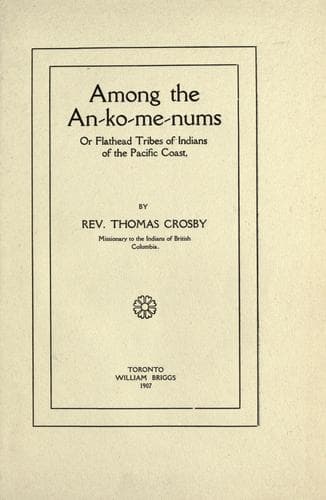
Among the An-ko-me-nums, or Flathead Tribes of Indians of the Pacific CoastCrosby, Thomas
History
Among the An-ko-me-nums, or Flathead Tribes of Indians of the Pacific Coast
Crosby, Thomas
Indians of North America -- Missions; Salish Indians
Don’t wonder if the missionary, above every other man, should be a
strong total abstainer and hate the very sight of liquor or its trade.
CHAPTER XIV. _SOME PERILOUS CANOE TRIPS._
“When passing through the watery deep,
I ask in faith His promised aid;
The waves an awful distance keep,
And shrink from my devoted head.
Fearless, their violence I dare,
They cannot harm--for God is there.”
--_C. Wesley._
Soon after I got the language of the people, other teachers took the
school work, and I went out travelling from place to place, literally
“paddling my own canoe.”
There were few steamers in those days, and none between Nanaimo, the
centre of our work, and New Westminster and the Fraser River, where I
was often called in my labors among the natives.
These trips were invariably made by canoe, except for the chance of
catching the river steamer which journeyed from New Westminster to Yale.
The canoes of the Pacific Coast are of the type usually called
“dug-outs,” that is to say, they are mostly cut out of a cedar log.
In the south, the large ones were spoken of as “Chinook” canoes, with
rather a stub or short stern and a very high bow or neck. There were a
great variety of smaller canoes used for hunting and fishing, as well
as what they called a “spoon canoe,” flat-bottomed and nearly straight,
with hardly any bow or stern, which was used for travelling on very
shallow rivers. These latter were often made of cottonwood, while the
other types were always made of cedar.
The largest canoes were made in the north. The great war-canoes, with a
very heavy bow and stern, and capable of carrying easily fifty or sixty
people, were so shaped that, when properly managed, they would sail
over almost any sea. The Hydahs of Queen Charlotte Islands made the
largest and best canoes; they had larger cedar trees on their islands
than could be found on the mainland opposite. These canoes were often
from thirty to forty feet long and five or six feet beam, a beautiful
model, with gracefully shaped bow and stern, that would in English
phraseology be called a “clipper” for sailing. One of the largest of
these canoes, seventy feet in length by eight feet beam, was presented
to Lord Lorne when he visited British Columbia during his term of
administration as Governor-General of Canada.
Public-domain text, read in full here on John Shaqi.
Reviews
Reviews
No reviews yet
Be the first to share your thoughts on this work.
Elsewhere in the archive
Join the Discussion
Join the discussion
Sign in to leave a comment or review.
Sign InorCreate an account